Categories
Uncategorized

Growth of AI Chatbots in Enhancing CSR

An emerging trend taking the business world by storm is the upsurge of AI capabilities in business operations to improve and revolutionize internal processing systems and increase productivity.

ML chatbots are growing rapidly sophisticated with modernized designs for businesses struggling to communicate and interact with their clients.

Chatbots are programmed to respond to queries with prompt answers. This is a crucial means of meeting client expectations. Such quick personal replies also mean higher client participation and total satisfaction.

Recently, these tools have advanced functionalities, utilizing conversational AI and ADMs to link with clients or workers. End users can reap multiple functionalities, including scalability, usability, flawless integration, and sturdy analytics. 

What Are Its Functionalities?

These are advanced assistants with a conversational interface designed to smoothen communication with large organizations. These advanced AI models perform much more than answering consumer responses, optimizing internal processes, generating leads, reducing costs, and using machine learning. 

Leveraging these functionalities allows employees to complete tasks independently. Generally, it reduces human resources costs, which increases productivity for different departments and teams within the business. 

Like other chatbots, the AI version employs 24/7 operational support and handles multiple client conversations for businesses like medical offices, legal offices, insurance agencies, or academic services like essayusa.com. It reduces wait times and improves productivity. 

How Do They Work?

Your business type decides the type of bots to create. If your business involves customers reaching out for services and products, then chatbots are the way to go, and they will already help assess the economic benefit they provide.

Today, however, a single virtual assistant species of chatbot is being used for this purpose. This is why such posted virtual personal assistants are automated with chatbot-based corporate virtual assistants. To such an effect, it facilitates ‘protocols,’ affecting this virtual chatbot.

With Natural Language Processing, each user query is dissected into sentences. Thus, the machine can understand what you’re asking. Furthermore, machine learning allows bots to learn from human interaction and improve their answers automatically. They are immersed in diverse data, constantly providing effective feedback. In addition, their performance is optimized.

Step-By-Step Guide on How They Work

Here is a procedural guide on how these chatbots work to provide useful output for consumers:

User input: The operation begins when a customer presents an input—any input, such as words, images, videos, or audio.

Input analysis: The advanced program processes the input using NLP. Later, it breaks down the sentence into individual words or phrases to further comprehend the original intent. 

Intent recognition: Once the user makes a request, the intelligent assistant recognizes the user’s intent to respond. This is done by the machine learning algorithm that associates the user’s input to an intent based on what the virtual assistant learned from past user responses.

Response generation is the stage at which the chatbot processes the user’s query, command, or response and generates a reply. If it is query-driven, a rule-based chatbot selects a pre-written response from its software engine. Other more sophisticated self-learning chatbots employ machine-learning algorithms to generate appropriate responses.

User output: The assistant responds the purchaser. Later on, the end user can reply to the program, and the operation begins over again. 

Significant Role AI Plays for Businesses

These advanced AI conversational platforms currently bear multiple use cases in the practical business landscape. The popular roles of these tools include:

Cost Saving

Using the capabilities of these tools is affordable and more scalable than hiring customer service agents. For instance, the best essay writing service can rely on chatbots to automate routine responsibilities, such as customer service, task management, data entry, invoice processing, or reporting.

It allows human employees to carry out other responsibilities that require a personal touch, such as decision-making, accounting and auditing, general administration, or sales and marketing.

Customer Service

The entry-level requirement for chatbots is offering round-the-clock customer support, appropriately answering queries, and resolving consumer-related issues. Furthermore, these programs can collect feedback and insights to improve products and services. 

It can also automate customer service-related tasks like automated email responses, automated ticket routing, customer surveys, workflow automation, or password resets. 

Sales and Marketing

Most companies already use capabilities to generate leads in their sales and marketing departments. First, with their help, one of the most common 24/7 customer services is provided, to which all those who need help can always turn.

Implementing this tool will bring the highest satisfaction and loyalty to the clientele. Moreover, such tools can make personalized recommendations and suggestions based on collected client data and thus make the most efficient sales, leading to the largest conversions.

User Engagement

For instance, using these AI tools, business management can detect possible gaps in the customer conversation and quickly resolve inquiries or complaints.

Still, the tone and pace of the conversation with the customer can be changed mid-conversation to improve customer response and satisfaction. Advanced NLPs help precisely understand the client’s question and deliver a quick response.

Data Collection

The entry-level part of these programs responds to queries, while advanced algorithms gather data to gauge satisfaction levels with these replies. Also, it adjusts the conversation flow to provide better, more accurate, more relevant, and restored responses depending on the nature of the customer’s interactions. It helps a business understand its customers and their needs better. It can track what products customers are more interested in, their preferences, and their general feelings about them. 

Improving Employee Experience

A positive employee experience is essential for business success. Most companies invest in positive employee experiences to build their brands and attract and retain the best talent. Integrating these tools guides new employees through routine customer service training programs to get acquainted with the work environment.

Moreover, it provides immediate responses and answers to customers’ commonly asked questions. It can also create personalized training paths for new employees to accelerate their learning process for fast customer handling skills. 

Personalized Services

Users can easily program the software to converse with end users and foster a mutual relationship. Chatbots can also gather data to comprehend preferable customer needs and expectations. Afterward, they can analyze these insights to tailor responses and recommendations. Customers can use personalized services like feedback and guidance to support them through the initial learning phases. 

Final Words 

Machine learning programs present limitless opportunities to enterprises that want to take advantage of their features and functions in the modern business world. It helps improve operations of business and enhances customer involvement. Sales acceleration, price reductions, user engagement, and better personal services are some outlets to be used by businesses to continue growing.

Categories
Uncategorized

Agile budgeting: why companies need to become increasingly flexible

Corporate culture is changing. Today, companies are faced with strong international competition and have to react. Agile and solid financial planning is required in order to be able to react to the market as flexibly as possible. This article shows how it can be integrated in practice and what positive effects it has.  

A direct comparison of budgeting models: agile vs. traditional  

Every company uses different budgeting models: flexible or agile and traditional. Both have their advantages and disadvantages. Agile budgeting is known above all for its rapid response to market changes. Various financial planning and analysis solution are used for this.

Budgets are reviewed in short cycles (monthly or quarterly) and there is no fixed annual budget. This allows companies to react actively to changes in the market and thus gain a competitive advantage. Another advantage is the centralized decision-making authority. Individual teams in companies have the autonomy to make decisions within defined framework conditions.

Thanks to continuous monitoring of financial data in real time, problems are quickly identified. An essential key to this successful concept is the responsibility of individual teams. They act independently and therefore have a greater awareness of costs and a higher drive for success.

Classic budgeting in contrast

The opposite of agile budgeting is the classic model. Here, a fixed budget plan is drawn up annually. It allows for little to no adjustments. The management structure is also different. Teams have little to no responsibility, but are determined by the upper management level. This offers less scope for independent decisions. 

This method is interesting for large, established companies. Due to their stability in the market, they have experience and can plan the budget better once in advance. The conventional budget model also offers some advantages for other sectors with a low rate of change. These include utilities (such as the energy and water industries) and the public sector. Projects with a long-term focus (such as infrastructure projects) or companies with low market volatility also use the model successfully.

Risks in the absence of agile financial planning

Due to globalization and the increase in online business, some sectors are under enormous pressure. Companies that have always relied on traditional budget models have had to admit defeat to agile market mechanisms.

Examples of this are Nokia and Toys “R” Us. The former mobile phone giant had strong market power for many years. However, with the emergence of new mobile phone manufacturers, it is now under strain. The company suffered huge losses due to its slow adaptation to the smartphone market. One reason for this was the rigid budget planning that still existed from the former market leadership.

Toy company insolvent due to inflexible financial structure

Inflexible financial structures and a failure to adapt to online retailing contributed significantly to the insolvency of Toys ‘R’ Us. This long-established company suffered from a rigid, traditional budgeting strategy that did not allow it to react quickly to changing market conditions. The lack of agile budget planning meant that the company was unable to recognize and implement important market trends in good time.

The former US company worked with a fixed annual budget that was only reviewed and approved once a year. This inflexible planning prevented quick adjustments to market conditions. Competitive companies such as Amazon and Walmart invested early and agilely in their online presences. Toys “R” Us, on the other hand, stuck to traditional business models and reacted too slowly to the digital transformation.

Urgently needed investments in technology and e-commerce were not made in time. As a result, the company was unable to keep pace with the rapid development of online retail. Customers migrated to more flexible and better-positioned competitors. The lack of an online presence led to significant sales losses. 

Agile budget planning would have enabled Toys “R” Us to regularly review and adjust its budgets. Short planning cycles and flexible resource allocation would have enabled the company to react more quickly to market changes. Investments in online retail and digitalization would have been made in good time, which would have significantly increased competitiveness.

Categories
Uncategorized

How to Craft Compelling Audiovisual Content Using Free Tools

Creating compelling audiovisual content doesn’t have to be expensive. In early 2024, a variety of free tools emerged, making professional-quality production accessible to everyone.

From intuitive script writing aids and advanced voiceover tools to seamless video editing platforms, the possibilities are endless. You can now craft engaging narratives with ease.

Want high-quality audio? Find royalty-free music or sound effects online. Need visuals? Explore stock footage libraries at no cost. 

Let’s dive into these tools and transform your creative vision into reality.

AI-Powered Script Writing Tools

AI-powered scriptwriting tools revolutionize content creation by streamlining the writing process. The not-so-far past has seen an influx of these innovative solutions, helping creators generate engaging scripts effortlessly.

Platforms like ChatGPT and Jasper provide smart text suggestions, refining your ideas into compelling narratives. With intuitive interfaces, they make scriptwriting less daunting.

Want to boost productivity? Use these tools for instant brainstorming or fine-tuning dialogue. You’ll save time and enhance creativity without sacrificing quality.

Using Voice Generation for Authentic Narration

For your audiovisual content to strike a chord with the intended audience, audio just has to be on point. Clear and engaging voice overs make all the difference in retaining viewer interest and delivering your message effectively.

Enter voice generation tools, which help save time and money by bypassing the need for expensive recording equipment. Tools like Genny’s voice generator from Lovo.ai offer high-quality synthetic voices that sound remarkably human. You can customize tone, pitch, and pace to suit your narrative perfectly.

Such are innovations that elevate your project without stretching your budget or compromising on quality.

Free Video Editing Software: Maximizing Your Creativity

Proper editing is paramount in crafting a polished audiovisual piece. Imagine you’ve shot an engaging sequence but without the right cuts and transitions, your message may fall flat.

Fortunately, choosing video editing software like DaVinci Resolve or HitFilm Express can help you transform raw footage into compelling content. These free platforms offer professional-grade tools for trimming, layering effects, and adding titles effortlessly.

Maximize creativity by experimenting with color correction or incorporating slow-motion scenes. These intuitive tools ensure your vision comes to life smoothly and professionally without any cost barriers.

For those aiming to unlock an extra level of personalization and customer engagement, professional-grade solutions like Idomoo enable the creation of dynamic, individualized video content at scale. Integrating such platforms with the free tools mentioned above allows brands to deliver personalized videos that boost retention, increase ROI, and strengthen connections throughout the customer journey.

Adding Royalty-Free Music and Sound Effects for Professional Audio Quality

Carefully chosen, sound effects and music can make a world of difference in enhancing the mood and impact of your audiovisual content. They add depth, making scenes more immersive.

Platforms like FreeSound or Incompetech offer a vast library of royalty-free options to elevate your project’s audio quality. Consider these tips:

  • Match the music’s tempo with your video’s pacing.
  • Use subtle sound effects to underscore key moments.
  • Layer ambient sounds for richer background audio.

By thoughtfully integrating these elements, you’ll achieve professional-level results that captivate audiences.

Leveraging Free Animation Software for Dynamic Visuals

Animated videos have surged in popularity lately, captivating audiences with their dynamic and engaging visuals. Brands like Dropbox and Slack have successfully harnessed animations to explain complex concepts succinctly.

Now, creators can tap into this trend without breaking the bank. Tools like Blender and Synfig Studio provide robust features for crafting professional animations at no cost.

Harnessing these free resources, you can add motion graphics that elevate your content’s visual appeal. It’s an accessible way to create stunning visuals that resonate deeply with viewers.

Combining Multiple Free Tools to Create a Cohesive Project

Last but certainly not least, merging various free tools can produce truly cohesive audiovisual content you can even use in video marketing. Seamlessly integrating different platforms ensures each aspect of your project shines.

Here’s how to combine them effectively:

  • Use AI scriptwriting for a solid narrative foundation.
  • Enhance voice overs with sophisticated voice generation software.
  • Edit videos using robust free editing tools like DaVinci Resolve.

This multi-tool approach maximizes creativity while keeping costs low, resulting in polished and professional-quality content that captivates your audience from start to finish.

Final Thoughts:

In sum, creating high-quality audiovisual content is accessible to all with the right free tools. From scriptwriting and voice generation to video editing and animation, these resources democratize creative expression.

Imagine the possibilities when barriers fall – your vision brought vividly to life without financial constraints. The future of content creation is now within everyone’s reach.

Categories
Uncategorized

Factors To Consider Before Selecting The Right SEO Audit Tool For Your Website

Auditing your website for search is one of the primary ways to improve your online presence. It helps you identify the core issues and offers solutions to rectify errors.  

SEO auditing tools also enable the creation of an action plan for the site’s overall search engine optimization.  

Therefore, a good SEO audit tool will ensure that the website is always in good shape and that Google will not penalize your hard work.  

In this article, we will emphasize factors that will help you choose the best SEO audit tool.  

Factors To Consider Before Selecting The Right SEO Audit Tool 

Here are important factors that will help you select the right SEO audit tool.  

1. Consider Technical Features  

When you optimize your site from scratch, you need to ensure that it is easily crawlable by most search engines.  

In addition, you need to select a tool that can spot a robot.txt file. In addition, look for a tool that can show you the number of pages indexed by search engines.  

Thus, you need to know the current performance of your search engine optimization efforts. You will receive a warning about your site’s SEO when this number is lower.  

So, when the number is good, you can rest assured that the optimization is conducted well. If you own a medium- to big-size website, you need assurance that the technical features are present in the tool of your choice.  

2. Analyze Keywords  

Since keyword running directly affects your site’s overall search engine optimization, one of the best things a tool can do is track the keywords. It also helps you find terms on your website.  

Thus, these factors are a must-have feature when selecting an SEO auditing tool. 

Similarly, there are tools that can detect a few keywords on the website. These tend to be inefficient and present a false picture.  

Therefore, you need a tool to track overall progress, present a daily report, and compare keyword efforts with other websites. Generally, a good tool should be able to track a minimum of 250 keywords.  

Remember, the tool you choose should provide you with a monthly volume.  

3. Check On-Page Optimization  

It is a well-known fact that SEO that the search engines and visitors do not use content in the same way. This is where on-page optimization comes into the picture.  

Therefore, on-page optimization assists in appeasing every kind of audience.  

Thus, if you are looking for the right tool, a free SEO audit by Digitrio is one of the best. It is a data aggregator that assists in conducting bulk analysis and includes on-page optimization for the website.  

4. Check Website Accessibility  

While accessing a website, there are many things you can get in the way. It can be either a slow webpage load speed, 404 errors, or a long server response. These issues can be found easily in technical SEO auditing.  

Therefore, to check for accessibility issues on a website, you can simply go to Google Page Speed Insights.  

In addition, you should check Google Search Console for any errors that need updated content.  

Furthermore, if your site has an accessibility issue, you can fix it using Google resources.  

5. Usability  

It is a personal choice, but stability is a concern for every website.  

Thus, you need to make sure that your website works on the most popular browsers and devices in the world.  

Similarly, some tools can only audit websites of small sizes. This is why you must acquire a minimalist, clean, clutter-free interface.  

Therefore, a good tool will help you improve the website’s user experience.  

6. Proper Indexing And Crawling  

Google reads a website through the crawling process, while indexing adds web pages to Google search results. Therefore, both components are the foundation of a successful SEO site audit.  

Thus, you can turn to Google Search Console to determine whether a website is being effectively indexed and crawled.  

Furthermore, have a look at the robots.txt file to check which resources are blocked by the crawlers.  

You can ensure a proper setup by checking your website’s indexing and crawling to overcome the challenge.  

Execute The Right SEO Audit  

Thus, you have an option to select an SEO tool. However, it is a must-have for the efficiency of your website.  

Furthermore, you can consider the website’s dynamics and the above-mentioned points when choosing the right SEO audit tool.  

Hence, take advantage of these tips and select the best tool for the website.  

Categories
Uncategorized

PDF to Word Converter — A Comprehensive Guide

No doubt, PDF to Word converter has become an essential part of students’ and professionals’ daily tasks. So, if you want to edit, update, or extract text from your PDFs, you will need a reliable conversion tool. How to convert PDF files into Word documents? Which conversion tool is the best? 

This guide will solve all your queries and give you step-by-step instructions. Let’s scroll!

History

Years ago, converting PDF to Word was a tiresome task, requiring premium softwares/online conversion services. However, these tools offer inadequate results, loss of data loss, and formatting issues, allowing users to fix these errors manually. 

In today’s era, PDF to Word conversion has become easier and simpler due to the presence of various online/offline solutions. These tools are equipped with OCR and advanced algorithms, extracting text and maintaining formatting accurately. 

Moreover, in the future, PDF to Word conversion will become more efficient and accurate due to the exceptional AI tools, resulting in better recognition and exceptional results.

Reliable PDF to Word Converter Tools

There are numerous free tools, letting you convert PDF to Word easily. They include:

  • SmallPDF
  • Online-Convert
  • Adobe Acrobat

These reliable online tools convert your PDF files in a few minutes, making your life easy. However, there are some desktop softwares, converting your PDF to Word and offering additional attributes such as: batch processing, password protection, and editing. These softwares are:

  • Adobe Acrobat Pro DC
  • PDFelement
  • Nitro Pro

How To Convert PDF To Word — A Step-By-Step Instructions

Let’s convert PDF files to Word documents with various methods! These include:

  1. Conversion with SmallPDF

SmallPDF is a reliable PDF to Word converter, offering user-friendly interface, data security, premium conversion, and compatibility with all browsers and operating systems. Its conversion steps include: 

  • Navigate to SmallPDF.com.
  • Hit the “PDF to Word” button.
  • Now, hit on the “Select files” button and choose your desired PDF file. You can also drag and drop your file into the designated area or import your file from cloud storage which include: Dropbox & Google Drive.
  • Let the file upload and wait for the conversion to take place. It will take only a few seconds only. 
  • Download your converted Word document. You can also save the file directly to your Dropbox/Google Drive.

Let’s convert your files with desktop software!

  1. Conversion with Adobe Acrobat Pro DC

How can you convert your PDF to Word with Adobe Acrobat Pro DC? Follow these steps:

  • Install Adobe Acrobat Pro DC software. After installation, launch it on your desktop.
  • Navigate the “File” menu and click “Open”.
  • Select your desired PDF document you want to convert.
  • Again go to the “File” menu and hit the “Export to.”
  • choose “Microsoft Word” as the file type.
  • Save your  newly converted Word document to the desired location on your PC and click “Save.”

Let’s convert your PDFs with Microsoft Word!

  1. Conversion with Microsoft Word

You can also convert your PDFs to Word files by following these steps:

  • On your desktop, open Microsoft Word.
  • Visit to the “File” menu and click “Open”.
  • Locate your PDF file you want to convert.
  • Let the file be converted.
  • Your PDF will be converted to a Word document and will appear in a new window.
  • Navigate the “File” menu and click “Save As.”
  • Choose “Word document” as the file type and select a location on your PC to save the newly converted Word document.

Advantages of PDF to Word converter 

The notable advantages of PDF to Word converter are:

  • You can easily edit and modify your content.
  • It preserves the original images, fonts, and layouts of your content. 
  • PDF to Word conversion also helps multiple users to edit the content simultaneously, offering seamless collaboration. 
  • Word files are more searchable than PDF documents, letting you find your information easily. 

Tips for Best PDF to Word Conversion

For optimal conversion, you must check the following factors:

  • Select the reliable PDF to Word converter for high-quality conversions and exceptional accuracy. 
  • Evaluate the quality of your PDF files for accurate results. Low quality will result in poor clarity.
  • Review your newly converted Word document and pay attention to images, layouts, tables, missing elements, and formatting. 
  • Ensure your newly downloaded Word document is properly secured. 
  • If your PDF contains scanned images, select a converter with OCR system for text accuracy. 

Wrapping Up

No doubt, there are several tools, softwares, and AI-powered platforms (Scholarly) that convert PDF to Word documents. These tools, platforms, and desktop softwares offer user-friendly interfaces and quick conversion process, providing flexibility, seamless editing, amazing formatting, and convenient collaborating on your newly converted Word documents. However, each tool has its own pros and cons. So which one is the best? It depends on your needs and personal preferences. 

So, choose the right conversion tool and make your occasional conversions/ daily document management hassle-free.

Categories
Uncategorized

How to Leverage Online Tools for Effective Sales Training

In a world that’s increasingly run by technology, your sales team needs to adapt swiftly to new tech and tools to keep up. Especially as you navigate through 2024, maximizing online tools for effective sales training becomes more crucial than ever.

But with the right digital tools and resources, sales professionals like you can remain agile, informed, and ready to seize every opportunity your market may offer. These insights might just be your most-needed tricks to use online tools to their max.

Leveraging Online Technology

Embracing E-Learning Platforms

Some e-learning platforms, like Vengreso and others, can help you get maximum benefit in training your sales staff. These platforms offer more tailored courses designed after thorough research and by experts in various industries.

Their sales training and courses are also quite easy to access, especially with their flexible slots, which your staff can easily fit into their busy daily work schedules. Most of these online platforms can ably provide interactive components that’ll be easier for your team to grasp. 

With quizzes and virtual workshops to reinforce knowledge retention and effective learning, you’re sure these training hours will be worth it.

Using Simulation Software

Many trainees, especially pilots, will tell you they wouldn’t dare fly a plane without simulation training. It’s also very true within the sales network, especially salespeople who benefit handsomely from simulation software.

Some platforms can create many realistic selling scenarios where your reps can practice and polish their skills, which can result in more organizational benefits. It’s in these “simulated” environments that your staff can experiment with their strategies without fear of real-world rejection and repercussions. Here, they fail, learn, adapt, and improve their sales techniques in a controlled setting.

Implementing AI-Powered Coaching Tools

It’s truly groundbreaking when AI-powered coaching tools have permeated sales training, such as:

  • Gong

This AI coaching tool analyzes sales conversations to highlight, to your staff or trainee, some successful strategies and, at the same time, pinpoint areas for improvement. It will also provide real-time feedback based on patterns in the dialogue.

  • Chorus.ai

This AI-powered tool can offer sentiment analysis and talk-time ratios, where they can identify key engagement moments and suggest (to your team) best practices from top-performing reps.

  • Highspot

It’s another AI tool that integrates with CRM systems, offering your staff personalized coaching based on their performance data. This can align sales strategies with customer engagement insights.

  • ExecVision

This AI coach focuses on conversational intelligence, breaking down calls into actionable insights. It can customize coaching based on team performance trends.

  • Wingman

It’s also an AI coach that captures sales calls and offers automated coaching cues during live conversations. This can help your sales reps respond more effectively in real-time.

These tools can effectively train your staff and function like you have a top-performing sales manager available 24/7 to guide each of your representatives. Embracing these tools can help you make sure your sales team stays agile and competitive. 

Maximizing Mobile Training Apps

Your people are always on the move, especially your sales representatives. It might be more beneficial for them to engage in mobile training programs and apps like MindTickle and Lessonly. It’s to make sure they’re also getting improvement training, even if they’re always on the go.

These apps can deliver bite-sized learning modules that your team can engage with during their breaks or commutes. Your staff can easily relate to these module’s interactive features, like gamification, that keep learners engaged. These tools also have push notifications to remind your people to complete their modules.

These mobile training apps’ flexibility can help you make sure of your team’s consistent learning without hassle and impediments in their assignments, making it an essential tool for today’s modern sales training.

Exploring The Power of Virtual Reality

Your team might find it more beneficial if they engage in Virtual Reality training. This could be what they need to become more stellar in their field. It can offer immersive experiences for your salespeople to practice their skills. Some tools, like Virtalis, can create lifelike scenarios where your staff can interact with virtual clients in realistic settings. 

This VR training lets your reps feel deeply involved, helping boost their confidence and skills retention and allowing them to refine their pitches and strategies to become more effective in real-world sales situations or transactions.

Bottom Line

These innovations and their “efficiencies” can drive your continuous improvement, boost engagement, and seamlessly prepare your sales team for real-world challenges. Embracing them today might just be the best informed decision you make to tweak your organization’s performance up the scale.

Categories
Uncategorized

From Sidearms to Rifles: Understanding Valorant’s Diverse Weaponry

Valorant is a tactical first-person shooter developed by Riot Games, that features a diverse gun library for players to choose from. The different weapons have their own distinct characteristics, having their strengths and weaknesses suited for players with different playstyles. Today, we have a detailed guide around the vast array of weaponry in Valorant, including sidearms, rifles and the strategies and tactics behind them. 

The Role of Weapons in Valorant

In Valorant, weapons obviously have a huge impact on the dynamics of engagements, and even entire matches. Using one of a selection of different weapons, with different ranges, accuracy, fire rates and damages to consider, the player must carefully choose the kind of weapon they wish to take into play. This is key to making smart weapons choices and raising your chances of success on the battlefield. On top of that, advanced strategies, such as using Valorant Hacks, bring out an entire new layer of the match, offering to impulse on innovation and get an edge against your opponents, in order to take the victory in the end. 

Sidearms: Versatile Backup Options

In Valorant, sidearms are the perfect backup guns that can save you when you’re out of ammo on your primary weapon. Though less powerful at range than a rifle or sniper rifle, sidearms are incredibly versatile and can do some serious work in the right hands. 

  • The Classic Pistol: Reliable and Accessible

Default Sidearm – The trusty classic pistol that can be used by all players as their default pistol. While it does not provide the same firepower as other weapons, the pistol is deadly at medium-to-short range and is very accurate. The backbone of early round buys and a reliable last resort, the trusty pistol is modest in price and easy to come by. 

  • The Shorty: Close-Range Powerhouse

The Shorty is a shotgun as a sidearm that works best in the hands of close-range fighters. The Shorty, for example, does a ton of damage and is very effective even over distance, but even just a few well-placed shots are a quick dispatch to even the strongest of enemies. Though its range and accuracy hold it back compared to other weapons, the Shorty is an excellent fit for aggressive roles and can help you surprise your enemies in close quarters. 

SMGs: Agile and Versatile

The Submachine guns (SMGs) are quick and versatile, with a good rate of fire and full of potential in close to medium range deals. SMGs: With their better rate-of-fire and mediocre damage output, SMGs are definite fits for aggressive players and can perform well in quick matches. SMGs may not have the extended range or the hitting power of Rifles, they more than make up for it with their incredible ability on the field of battle. 

  • The Stinger: Mobile Firepower

The Stinger is a lightweight SMG for the more aggressive players of the free-to-play battle royale game. As of now, this system scales with the number of players that Uberbot is attacking and it is by far not enough since players can spawn to their death mostly in private servers. The Stinger is not as reliable as a rifle, but in the right hands, it can be a very capable and potent weapon due to its speed and versatility. 

  • The Spectre: Silent and Deadly

As a silenced SMG, the Spectre favors stealth and precision over outright firepower. The Spectre has low recoil but deadly accuracy at close to medium distances, making it perfect for players who want to frag with style. Though we have to be real and say the Spectre may not be the wildest gun, it’s got its own flavors of exciting tricks that many stealthier or precision-loving players will love! 

Rifles: Precision and Power

Rifles are what make up most of any Valorant team, playing the majority of the engagements with the game and therefore should be the majority of your time in map. Rifles are some of the most versatile weapons in the game, ranging from assault rifles, with good range, and sniper rifles, which will most likely kill an operator before they can get a shot off. 

  • The Vandal: Precision Marksmanship

The Vandal is an all-around assault rifle that works best at medium to long ranges. The Vandal has an extremely high rate of damage and is accurate with controlled recoil, allowing you to pop heads off and take out players with minimal ammo. The Vandal has superior shooting power with a high-accuracy single-headshot kill and requires high-precision marksmanship to be used effectively. 

  • The Phantom: Silent and Deadly

High stealth and versatile weapon, being less powerful. The Phantom: perfect for those suppressed, close to mid-range pick-offs on low recoil, high damage. Whilst not as hard hitting as the Vandal, the Phantom’s stealthier nature and all-purpose usage make it a very popular option for slow-paced players to approach a round with a more subtle and strategic mindset. 

Sniper Rifles: Precision and Long-Range Dominance

Sniper rifles are elite long-range weapons for precision shooters. These long-ranged sniper rifles are known for headshot kills from a distance with the highest damage, making other enemies a piece of cake. Sniper rifles may take precision and practice to master, but they’re an incredibly dangerous weapon type to use, dominating enemies at long range with hitscan lethality.

  • The Marshal: Entry-Level Marksman

The Marshal is a budget mid-range sniper that brings precision marksmanship and long-range primacy to the arena. This is the weapon for players who can hit headshots and do it from far away. The Marshal dishes out high damage and uses a scope. The Marshal may not be as strong in the realm of one-shot kills as some other sniper rifles, but its competitive price and versatility have won it a faithful following among aspiring snipers and seasoned marksmen alike. 

  • The Operator: Precision Death Dealer

 With its stratospheric headshot, two-shot body kill, the Operator can dismantle other teams with just one or two well-tracked shots, holding massive menace in the hands of someone who aims well. With this power to change the flow of games with a single shot, the Operator will almost definitely be a favorite weapon on the battlefield, even if it does take patience and skill to use it properly. 

Crafting Your Arsenal

Weapons in Valorant can be customized for any particular style of the player. With a weapon for every style of play – from the agility of SMGs, the precision of rifles, and the lethality of sniper rifles – how you play is up to you. Try every weapon, learn the ins and outs of each, and choose your loadout wisely based on what every game asks of you. 

Conclusion

A very diverse weaponry in Valorant gives every player some real flexibility to shape their gameplay depending on the playstyle they are into. Every weapon in each type has its strategy and characteristics it brings to the fight, most notable between sidearms to rifles. You can maximize your effectiveness on the battlefield and dominate the competition in Valorant by learning the strengths and weaknesses of each weapon, mixing things up with various loadouts, and perfecting your skills with each weapon type. 

Categories
Uncategorized

The Benefits Of Using Push Messages: Enhancing User Engagement  

Capturing and maintaining user attention is more challenging now more than ever. Businesses and app developers are constantly searching for innovative ways to keep their audience engaged and coming back.  

One powerful tool to achieve this is push messages. These timely, personalized notifications are changing how companies communicate with their users, driving engagement, boosting retention rates, and enhancing overall user experience.  

This article discusses the many benefits of using push notifications. Read on to discover how push messages can take your business to the next level!  

Enhanced User Retention  

Push notifications are the secret sauce for keeping users hooked on your app in a less intrusive way than spam emails or pop-up ads. Think about it: you’re going about your day when a friendly ping reminds you to log today’s workout in that fitness app.   

These well-timed push messages jog your memory without being obnoxious. They feel personalized, almost like a friend reminding you about something important. That’s what makes them so powerful for reducing app abandonment and churn.  

Regular, tailored updates foster consistent usage by keeping your app top-of-mind. But unlike disruptive marketing, push notifications enhance engagement through gentle reminders that provide value. It’s a win-win way to retain loyal users long-term.  

Increased User Engagement   

Push notifications effectively drive user engagement by delivering timely, personalized content. A great example? Shopping apps send alerts about flash sales or new product drops. These contextualized notifications spark consistent interactions, cultivating loyal users hooked on the engaging experience.  

Varying message frequency, content, and time based on user behaviors allows you to maximize engagement. Regular yet thoughtful push messages keep users interested without overwhelming them. With insightful analytics, businesses continually refine campaigns for optimal impact.  

The key is to strike a balance between providing value and respecting user preferences. Relevant, snackable content boosts engagement organically, while excessive notifications risk disengagement. Leveraging push messaging nurtures relationships, delights customers, and fosters long-term brand affinity.  

Improved Conversion Rates  

The benefits of using push messages go way beyond just keeping users engaged. They’re a powerhouse for boosting conversions and sales. Think about how tempting it is when your favorite food app pings you with a mouth-watering deal on discounted tacos. You’re way more likely to hop in and place an order compared to scrolling through a basic promotion.  

That’s the magic of well-timed, personalized push messages. They create a sense of urgency that primes users to act. Whether it’s a limited-time sale, exclusive offer, or app-only discount, these notifications act as digital tappings on the shoulder that drive purchases. Innovative businesses leverage this to supercharge conversions in a far more cost-effective way than intrusive ads or blasting generic emails.  

Cost-Effective Marketing Tool  

Unlike traditional marketing channels like email marketing or SMS messages, companies don’t incur additional expenses for each message sent. This makes it an economical choice, more so for smaller businesses with limited budgets.   

Push campaigns have a high engagement rate because they appear prominently on devices people carry everywhere. Such a level of customer engagement translates into a higher return on investment compared to other marketing methods.  

Their high engagement potential maximizes marketing impact without straining financial resources. For cost-conscious brands, incorporating push notification campaigns into their marketing mix can be an invaluable strategy to connect with their target audience.  

Personalized And Customization  

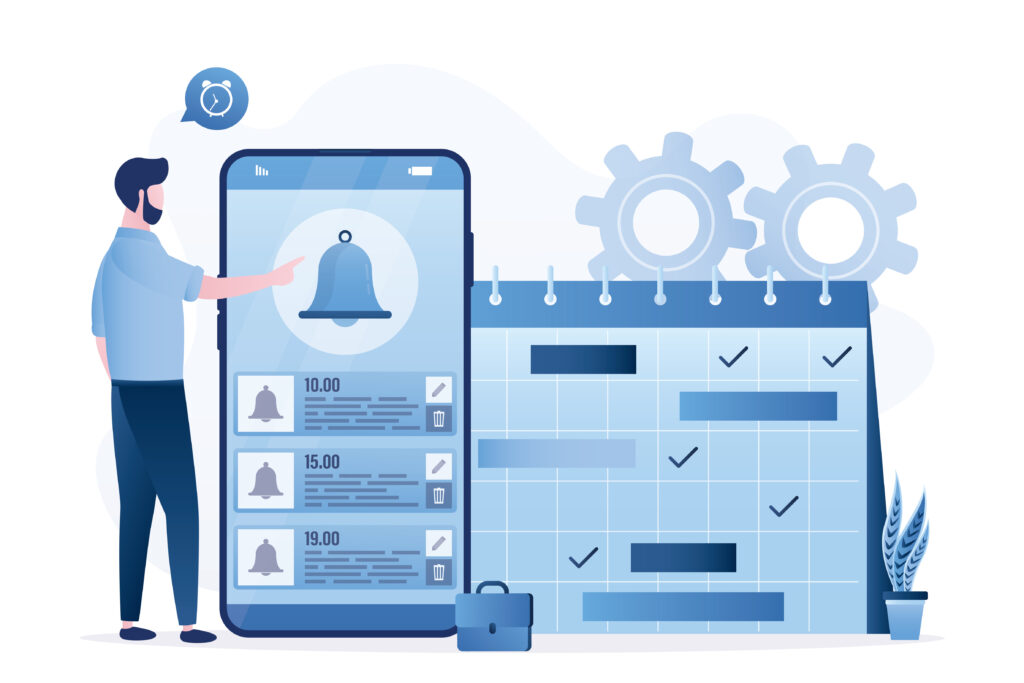
Businessman sets up notifications and an alarm clock on his smartphone. Paper calendar with notes. Alarm bell and time management app on mobile phone screen. Schedule of meetings and work. Flat vector

Businesses strive to connect with customers on a personal level. These messages provide a powerful tool to achieve this. By harnessing user data and analytics, companies can craft highly tailored messages. These notifications go beyond generic broadcasts, adapting to individual preferences and behaviors.  

Customized notifications make users feel valued and understood, enhancing their overall experience. However, personalization requires a delicate balance. Too many irrelevant notifications can frustrate users and damage the brand. Companies must use data responsibly, respecting privacy concerns. Clear communication about data practices builds trust.  

When executed thoughtfully, personalized push notifications provide a seamless bridge between businesses and customers. They transform impersonal mass messages into tailored conversions, fostering loyalty and engagement. In this digital age, this level of customization has become essential for standing out.  

User Feedback And Surveys   

Mobile push notifications are such a convenient way for companies to hear directly from their users. Instead of just blasting out one-way messages, smart businesses use them to open a dialogue. They’ll send a quick notification on your phone with a link to a short survey, just asking for a little feedback.

It’s a great way to take the pulse of how users really feel about the product or service. Are there any sticky points giving people headaches? What features are proving most useful? By staying looped in through these quick check-ins, companies can get a live read on what’s working and what needs improvement.

Plus, users appreciate when businesses consider their voices. They like feeling heard and knowing the companies they support actually care what they think. Having that open line of communication builds trust and brand loyalty over time. Customers stick around because they can see their input gets absorbed and the product experience evolves to suit their needs better.

So, while notifications can be disruptive if overdone, using them to solicit fast feedback is a win-win. Companies get invaluable user insights to guide their updates and road maps. And customers feel empowered knowing their voices directly shape the products they use daily.

Re-engagement Of Inactive Users  

It’s so easy for people to download an app, use it for a bit, and then kind of forget about it as life gets busy. That’s just human nature. But smart companies don’t just shrug and watch those inactive users slip away. They get proactive about luring them back in.

Push notifications are clutch for re-engagement campaigns. Consider a fitness app that notices you haven’t logged a workout in a month or two. They can ping you with a message to remind you about your fitness goals.

However, the best re-engagement campaigns don’t get spammy. They’ll analyze the specific user’s activity patterns and preferences to customize those nudges. For example, if a dating app user historically only logged on during work holidays, maybe they’ll hold their re-engagement push for then. Or a workout app might promotional new programs they know align with that user’s favorite types of training.

It’s all about using personal and relevant push notifications. Generic mass blasts don’t re-engage anyone. But a timely, tailored push notification campaign that reminds an inactive user about the value and fun they enjoyed with your product? That’s an incredibly powerful way to regenerate interest and activity. It keeps users from falling out of your ecosystem entirely.

Real-Time Communication  

Push notifications excel at delivering real-time updates instantly, which is crucial when you want to communicate an urgent message. From breaking news to live sports scores, these notification messages ensure users stay informed as upcoming events unfold.   

News apps leverage this feature to alert readers about developing stories, enabling them to stay ahead of the curve. Similarly, weather apps can push severe storm warnings, allowing people to take necessary precautions promptly. Event platforms use push notifications to share live updates, enhancing the experience for remote attendees.  

The ability to communicate in real time sets push notifications apart. This powerful feature transcends mere convenience, ensuring users remain connected to the information that matters most. From minor updates to critical alerts, the instantaneous delivery of web push notifications has become an integral part of our digital lives

Conclusion  

Push messages are a game-changer for businesses looking to enhance user engagement. They help keep users informed, connected, and active within your app. By sending personalized, timely notifications, you can boost user retention, increase engagement, drive conversions, and gather valuable feedback. Whether it’s through real-time updates, personalized offers, or re-engaging inactive users, push messages offer a cost-effective and powerful tool for businesses. Embrace push notifications to elevate your business and foster lasting customer relationships.

Categories
Uncategorized

How to Choose the Right Video Editor for Your Needs

Discover essential tips for selecting the perfect video editor to match your editing requirements and creative aspirations

Assess Your Editing Requirements

When it comes to assessing your editing requirements, thorough consideration of several factors is paramount in choosing the perfect video editor for your needs. Begin by evaluating the complexity of your projects, whether they entail simple edits or intricate post-production tasks. Factor in the desired features, such as transitions, audio manipulation, and text overlays, that align with your creative vision. Additionally, establish a budget that accommodates the software’s cost and any potential add-ons or subscriptions. Lastly, gauge your level of expertise to determine whether you require user-friendly interfaces or advanced functionalities like motion tracking and 3D effects. By carefully analyzing these aspects, you can make an informed decision and select a video editor that seamlessly integrates into your workflow, enhancing your editing capabilities and efficiency.

Consider Budget and Pricing Options

When selecting a video editor, it’s crucial to consider your budget and explore pricing options. Evaluate whether you need a free, budget-friendly, or premium software, weighing features against cost to find the best fit for your editing needs and financial resources. Additionally, look for subscription plans, one-time purchases, or trial periods to ensure you’re getting the most value for your investment in a video editing tool that aligns with your budget and editing requirements.

Evaluate Editing Features and Tools

When choosing a video editor, thoroughly assess its editing features and tools to ensure they align with your project requirements. Look for functionalities like trimming, transitions, effects, and audio manipulation, considering both basic and advanced editing needs. Additionally, examine the user interface to ensure ease of use and accessibility of tools. By carefully evaluating these aspects, you can select a video editor that empowers you to bring your creative vision to life efficiently and effectively.

Compatibility with Your Device or Operating System

Ensure the video editor you choose is compatible with your device or operating system. Whether you use Windows, macOS, or mobile platforms like iOS or Android, selecting software that seamlessly integrates with your system ensures smooth editing experiences without compatibility issues. Prioritize editors that offer cross-platform compatibility or versions tailored to your specific device to maximize flexibility and convenience in your editing workflow. Compatibility is crucial for ensuring that you can edit your videos efficiently and effectively on your preferred device or operating system.

Review User Interface and Ease of Use

When assessing a video editor, consider its user interface and ease of use. Look for intuitive controls, customizable layouts, and efficient workflows. A user-friendly interface ensures smoother editing processes, allowing you to focus on creativity rather than technical hurdles. Additionally, seek editors with clear tutorials or documentation to aid navigation. By prioritizing user experience, you’ll find a video editor that aligns with your skill level and enhances your editing efficiency.

Explore Additional Features and Effects

Explore the diverse array of additional features and effects offered by various video editing software options to elevate your editing experience. From advanced color correction tools to special effects and transitions, unlocking these creative possibilities can enhance the quality and impact of your videos, ensuring they stand out from the crowd.

Check for Customer Support and Resources

When selecting a video editor, ensure that it offers comprehensive customer support and ample learning resources. Look for platforms with responsive support teams, user forums, tutorials, and documentation to assist you in mastering the software and troubleshooting any issues that may arise during your editing process. This ensures that you have the necessary assistance and guidance to make the most out of your editing experience and achieve professional results with ease.

Read Reviews and Seek Recommendations

Before committing to a video editor, delve into user reviews and seek recommendations from fellow creators. Platforms like forums, social media groups, and review websites offer valuable insights into software performance, user experience, and compatibility with specific editing needs. Don’t hesitate to ask for recommendations from peers or industry professionals who have firsthand experience with different video editing tools. By gathering feedback from diverse sources, you can make a well-informed decision and choose a video editor that aligns perfectly with your creative vision and technical requirements.

Conclusion

In conclusion, choosing the right video editor is pivotal for achieving your creative vision. By considering factors such as features, ease of use, platform compatibility, and budget, you can find a tool that meets your specific needs. Remember to explore trial versions or demos, seek recommendations, and read reviews to make an informed decision. Whether you’re a beginner or an experienced editor, finding the right video editing software empowers you to bring your ideas to life and produce professional-quality content. With the right tools at your disposal, you can unlock your creativity and embark on a successful video editing journey.

Categories
Uncategorized

BranchTrack Vs. Skillsoft: Finding The Right Fit For Your Budget And Training Needs 

Ever started a new hobby? You get that excited, maybe slightly frantic, feeling, right? You spend ages looking up all the gear, comparing every feature, and trying to find the perfect thing that also fits your budget. Choosing an LMS (Learning Management System) for your company can be like that. An LMS is basically the central spot for all your employee training. It makes sure your team has the knowledge and skills they need to be excellent at their jobs.

But with a ton of LMS options out there, like BranchTrack and Skillsoft, how do you find the one that will really launch your business forward? Don’t worry; this guide will be your trusty advisor, helping you navigate the key features and considerations of both platforms to find the perfect fit for your budget and training goals. 

The LMS Selection Maze: Finding Your Way Out 

  • Option Overload: The LMS market is flooded with several platforms, all vying for your attention. Each has unique features and purposes, and determining the proper one may be as tricky as interpreting a highly complicated instruction manual. Imagine all the different learning management systems in front of you, each promising incredible benefits for your company. But which one has the features you need, fits your budget, and is easy to use for everyone? That’s the main challenge! 
  • Balancing Needs And Resources: Finding an LMS that hits all the right notes for your company can feel like a balancing act. You require something that addresses your individual training demands while still staying within your budget. While expensive, feature-packed platforms may appear appealing because they include several bells and whistles, they can also be costly. 
  • Future-proofing Your Choice: Do not get stuck in a dead-end! Consider the LMS’s scalability and adaptability. Can it grow alongside your organization and accommodate your evolving training requirements? 

BranchTrack: Streamlining Training, One Click At A Time 

BranchTrack appears as a user-friendly, cloud-based LMS designed to streamline the training process for organizations of all sizes. Consider a clean, straightforward design that even non-technical customers may use with ease. 

BranchTrack enables you to develop engaging courses, automate tiresome tasks, and obtain valuable insights through extensive analytics, all from a single, easy-to-use platform. 

Building Your Training Empire: BranchTrack LMS’s Strengths 

  • Effortless Course Creation: BranchTrack is a powerful content management system that allows you to upload current training materials or use the built-in authoring tools to create new courses from the start. Consider it your own digital course workshop, complete with all the tools needed to create exciting and instructive training content. 
  • Automation Army: BranchTrack’s robust automation capabilities eliminate repetitive activities. Automate procedures like enrollment, reminders, and credential issuing, freeing up critical time and resources for more strategic objectives. 
  • Data-Driven Decisions: BranchTrack’s extensive analytics package provides you with a wealth of data. Gain valuable insights into employee performance, discover knowledge gaps, and continually improve your training programs to ensure optimal efficacy. Consider it a window into your students’ brains, allowing you to personalize your teaching to their individual requirements. 

BranchTrack: Addressing Potential Shortcomings 

  • Content Library Considerations: BranchTrack provides course development capabilities, but its pre-existing material collection may be less extensive than that of its rivals. However, this is an excellent chance to utilize your own experience and tailor training content to your company’s culture and special needs. 
  • Pricing Puzzle: Pricing structures for LMS platforms might differ depending on the feature set and user volume. Carefully evaluate BranchTrack’s pricing plans to ensure they align with your budget and your organization’s size.  

Skillsoft: A Powerhouse of Content for Diverse Learning Needs

Skillsoft is a complete Learning Management System with an extensive and ever-expanding content base. Imagine a virtual library full of skillfully chosen courses on various topics catering to multiple skill sets and sectors. This is the core of Skillsoft: a one-stop shop for providing your team with the information they need to flourish. 

Unveiling Skillsoft LMS’s Strengths: A Learning Powerhouse 

  • Content Kingdom: Skillsoft’s claim to fame lies in its extensive content library. Consider it a feast of learning options, with courses ranging from software applications and compliance training to leadership development and corporate communication. This comprehensive collection ensures that you may locate the ideal training materials to meet your individual training requirements, regardless of industry or area of specialization. 
  • Integration All-Stars: Skillsoft collaborates smoothly with a variety of learning platforms and resources, enabling you to build an utterly unified learning environment inside your business. This removes the need to switch between platforms and streamlines the learning experience for your staff. 
  • Compliance Champions: Does your company need compliance training for specific regulations? Skillsoft has you covered. They provide a complete range of compliance courses to keep your personnel up to speed on industry rules and best practices. This reduces risk but also promotes an ethical culture inside your firm. 

Skillsoft: Weighing the Potential Drawbacks 

  • Price Point Ponderings: Skillsoft pricing is a bit tricky. The software’s huge content collection and feature set sometimes come at a higher cost than its competitors. While it provides variable price options, it is critical to thoroughly assess the cost-benefit analysis to ensure it is appropriate for your budget and organization’s size. 
  • Navigation Nuances: With such a vast library and array of features, Skillsoft’s interface might appear complex for some users. However, robust onboarding materials and user support can help bridge this gap and ensure a smooth learning experience for everyone.

BranchTrack Vs. Skillsoft: A Head-To-Head Showdown

Now that we’ve covered the merits and limitations of BranchTrack and Skillsoft, it’s time for the big event: a head-to-head comparison to help you choose your LMS champion. Here is a summary of some essential elements to consider:

Features BranchTrackSkillsoft
Content LibraryUser-built or limited pre-built contentExtensive pre-built content library across various industries and skill sets
Ease of UseUser-friendly interface, ideal for non-technical usersSlightly more complex interface, may require some initial training
PricingGenerally, more affordable, with plans catering to different sized organizationsPotentially higher price point, flexible plans available
Course CreationRobust content management system and authoring toolsLimited course creation capabilities, focus on pre-built content
AutomationPowerful automation features for streamlining workflowsFewer built-in automation features
AnalyticsComprehensive analytics suite for data-driven insightsRobust analytics capabilities for tracking learner performance
IntegrationsLimited integrations with other learning platformsSeamless integrations with various learning tools and platforms
Compliance TrainingLimited focus on compliance trainingComprehensive library of compliance courses across various regulations

Making the Winning Choice: It’s All About Your Needs 

Remember that the “perfect” LMS does not exist. The ideal option for your company depends on your unique requirements and budget. Here are some leading questions that can help you make an educated decision. 

  • Budget Constraints: Are you working on a tight budget, or do you have more room for a feature-rich platform? BranchTrack may be suitable for budget-conscious enterprises, but Skillsoft may be great if you want comprehensive material and integrations. 
  • Training Focus: Do you need to create custom training content, or are you primarily looking for pre-built courses? If customization is vital, BranchTrack offers robust content creation tools. If you prefer a vast pre-existing library, Skillsoft reigns supreme. 
  • Target Audience: Consider your target audience’s technical expertise. BranchTrack’s user-friendly interface could be more appropriate if you have a non-technical staff. However, if your employees are comfortable with technology, Skillsoft’s broader feature set can be explored. 

Conclusion: Finding Your Perfect LMS Partner 

Adopting a suitable LMS system is an investment in the long-term success of your organization. By carefully assessing your budget, training requirements, and target audience, you can confidently traverse the world of BranchTrack vs. Skillsoft.

Remember, both platforms offer unique strengths and functionalities. Be bold and take advantage of free trial periods or demonstrations to get a hands-on experience with each platform before making your final selection. Finally, the ideal LMS partner will enable you to develop a highly competent and informed staff, driving your firm to success.