Massage schedules change quickly, and small gaps can add up to lost revenue. A booking system helps keep availability accurate, reduces back-and-forth messages, and supports smoother payments.
This article explains the key features that matter most, then compares tools that offer them in different ways. It starts with Bookeo, which combines online booking, reminders, client records, and staff calendars in one dashboard.
From there, it reviews options like Regiondo, TRYTN, Hotelogix PMS, and MyHotelLine PMS for practices with different sizes and workflows. The goal is clear comparisons and better scheduling decisions.
Bookeo
Bookeo is a user-friendly scheduling system for massage therapists and wellness studios that want to manage online bookings, payments, and availability in one place. Clients can quickly check real-time openings, book an appointment, and pay from any device, without needing to call or message back and forth. The booking page can also be customized to match your brand, so the experience feels consistent from start to finish.
On the business side, Bookeo keeps appointments, client details, payments, and staff schedules organized in a single dashboard. Automated confirmations and reminders help cut down on no-shows and reduce front desk work, which is especially helpful for busy clinics. It also supports different service formats, like individual sessions, packages, and recurring appointments, so massage businesses can stay flexible without juggling multiple tools.
Bookeo Key Features
Automatic reminders and follow-ups: Branded emails and optional texts confirm bookings, remind clients, and support post-class feedback.
Customer database: Build or import client lists and keep contact details and booking history in one system.
Staff and trainer availability: Set working hours, time off, and control what each instructor can view or manage.
Calendar sync: Two-way sync with Google Calendar, Apple iCal, and Outlook keeps personal and studio schedules aligned
Bookeo Pros
Bookeo adds tools for studios that run busy timetables. You can set class or appointment times, define different durations and prices, and apply booking rules such as minimum notice or limits on how far ahead clients can book.
Marketing features support add-ons, multi-item booking carts, prepaid packages, gift certificates, and memberships. Reporting dashboards show booking volume and revenue by class type or instructor, helping owners track performance without extra spreadsheets.
For hybrid delivery, Bookeo supports both in-person and online classes within the same schedule.
Bookeo Best For
Bookeo suits fitness businesses that need clear class management and steady self-serve schedule bookings. It fits gyms, yoga and Pilates studios, swim schools, and trainers running group sessions or personal lessons.
Multi-instructor teams benefit from shared calendars and role-based access, while smaller studios gain time back through reminders and online payments.
If your operation depends on filling class slots, avoiding double bookings, and keeping client data current across devices, Bookeo matches that setup well.
Regiondo
Regiondo brings exciting features to spa professionals who need an all-in-one solution.
Regiondo Key Features
Regiondo gives day spas and wellness centers tools that do more than just handle bookings:
24/7 appointment scheduling on your website creates a continuous connection with customers
Custom intake forms capture medical history and priorities before check-in
Social media booking links connect with Facebook, Instagram, and TikTok
Website Builder lets you create responsive sites without coding skills
Easy-to-use calendar displays daily schedules and resource allocation
Automated review collection builds your online reputation
This system organizes your daily schedules and matches clients with treatment providers. Resource management becomes simple as it tracks spa rooms, equipment, and other assets.
Regiondo Pros
Customers praise Regiondo’s easy-to-use design. A customer shared: “The software is very easy to use when you get used to it, it is very efficient and I felt like it made a big difference on bookings”.
The platform handles payments through multiple currencies using cash, credit cards, or PayPal. Their core team provides free setup and unlimited training with round-the-clock support.
Regiondo Best For
Day spas, med spas, and wellness centers find Regiondo a perfect match. The Starter plan costs €49 monthly, which suits small businesses starting their online journey.
TRYTN
TRYTN proves to be a solid appointment software that makes business operations easier.
TRYTN Key Features
TRYTN blends online booking features with robust reservation management tools.
The platform gives you:
Direct online sales across all devices 24/7
Option to edit, reschedule or refund existing reservations
Support for multiple business locations
Asset management to prevent double-booking
Gift certificate and merchandise sales among services
The platform creates custom reports quickly and accurately. TRYTN supports multiple languages and currencies for businesses operating internationally.
TRYTN Pros
Users love TRYTN’s user-friendly design. A reviewer shared, “This booking system saves me hours a week”. The platform runs about four times faster than its competitors. This speed helps prevent clients from abandoning their booking process.
The software has built a strong reputation for its complete reservation management. You can match your brand’s look throughout the booking experience with its customization options.
TRYTN Best For
TRYTN shines for:
Massage practices with diverse service packages
Therapists running multiple locations
Businesses that track marketing campaigns
Practices that need flexible pricing options
Your massage therapy business can boost revenue with TRYTN’s dynamic pricing for peak and off-peak hours. The deposit-only pricing feature helps reduce cancellations by getting client commitment upfront.
Despite its strengths, larger practices might find it challenging at first. One user noted that “it’s very hard to switch away from” once fully implemented.
Hotelogix PMS
Hotelogix PMS stands out as another excellent choice for massage therapists who manage larger operations.
Hotelogix PMS Key Features
Hotelogix’s cloud-based system makes booking management easier through:
Front desk module with drag-and-drop reservation features
Mobile app that lets you manage operations anywhere
Up-to-the-minute syncing between multiple booking channels
Centralized dashboard that displays all reservations
99.7% uptime reliability and 24/7 support from real people
The platform reduces your team’s workload through automation and gives clients digital check-in options. The user-friendly design and Automated Coaching Engine make staff training simple.
Hotelogix PMS Pros
Since 2008, Hotelogix has built a strong reputation for its straightforward interface. Most users complete checkouts 50% faster. The system cuts down manual errors so you can spend more time caring for clients.
Night audit processes run automatically to create reports about room details, revenue, and taxes. The Manager Flash Report quickly shows performance metrics for any time period.
Hotelogix PMS Best For
Hotelogix fits perfectly with massage therapy businesses that have:
Multiple locations under central management
Services beyond simple massages
A need to track finances in detail
Staff who need to learn quickly
Massage therapists who need reliable appointment software will find that Hotelogix delivers consistent performance with over 100 third-party integrations.
MyHotelLine PMS
MyHotelLine PMS offers robust tools for massage practices that need more advanced features.
MyHotelLine PMS Key Features
MyHotelLine gives massage therapy businesses everything they need in one package:
A booking engine lets clients schedule appointments right from your website
The channel manager links to travel agencies and cuts down booking problems
Room cleaning and maintenance tracking through housekeeping management
Tools that show you analytical insights about your business performance
You can run your business from anywhere with mobile access
Safe payment processing with multiple ways to pay
The system meets industry security standards to protect your data. The cloud-based platform lets you access your information from any device.
MyHotelLine PMS Pros
MyHotelLine PMS scores 4.6/5 overall from users. They love its value for money (4.9/5) and how easy it is to use (4.7/5). You can try it free before you buy.
A user shared, “Two Click Operations with Awesome support”. Another said, “Been in the industry for over 20 years, and haven’t found a software as comprehensive as MHL so far”.
Busy therapists will appreciate how the system stops double bookings automatically.
MyHotelLine PMS Best For
MyHotelLine PMS fits perfectly for:
Massage practices with multiple rooms that need complete management tools
Therapists who want website bookings
Businesses that need thorough performance reports
Practices taking online bookings from different platforms
The simple pricing structure makes sense for massage businesses watching their budget. Take a look at this appointment software if your single-therapist practice is growing.
Conclusion:
The right booking tools support daily work without creating more admin tasks. Bookeo covers core needs like real-time availability, automated reminders, client history, and calendar syncing, which suits therapists and wellness studios with recurring schedules.
Regiondo adds intake forms and social booking links, helpful for spas that rely on online discovery. TRYTN works well for multi-location setups and flexible pricing. Hotelogix and MyHotelLine PMS bring hospitality-style controls for larger operations that manage rooms, staff, and multiple booking channels.
Across all options, the best systems keep scheduling consistent, reduce no-shows, and make payments easier for clients and teams alike.
Video visits stopped being an experiment several years ago. In one analysis of US hospitals published on PubMed, the share offering telemedicine services climbed from 46% in 2017 to 72% in 2021, and the tools clinicians reach for are now ordinary conferencing platforms rather than dedicated medical hardware. That creates a problem that general buying guides tend to skip. A video platform is only usable for patient care if the vendor will sign a Business Associate Agreement, and most vendors will only sign one on certain plans. We compared six platforms that healthcare teams actually shortlist, and we checked each vendor’s own current documentation rather than repeating what other roundups say.
What HIPAA Compliance Actually Means for a Video Platform
The phrase “HIPAA compliant video conferencing” gets used loosely, so it is worth separating the four things that a healthcare buyer is really asking about.
HIPAA compliance. HIPAA is a law that applies to organizations, not a certificate that a software product earns. A platform can support your compliance program, but it cannot make you compliant on its own. What the law does require is a set of safeguards for electronic protected health information, and the technical safeguards standard spells out what those look like in practice: access control, audit controls that “record and examine activity in information systems that contain or use electronic protected health information,” authentication that verifies a person is who they claim to be, and transmission security for data moving across a network. Any platform you consider should be able to show you how it handles all four.
Business Associate Agreement (BAA). A BAA is the contract in which a vendor accepts legal responsibility for the protected health information it handles on your behalf. Without a signed BAA, using a platform for patient care is a violation regardless of how good the encryption is. This is the single most important thing to verify, and it is almost always plan-conditional. The same brand name can be perfectly acceptable on one subscription tier and off limits on another.
End-to-end encryption. End-to-end encryption means the media is encrypted on the sending device and decrypted only on the receiving devices, so the service provider in the middle cannot read it. Several vendors in this category describe their calls as encrypted without meaning end-to-end in that strict sense. Encryption in transit using TLS and SRTP is common and is what most enterprise platforms document. Both can be acceptable under a BAA, but they are not the same claim, so read the wording carefully.
Telehealth and virtual visits. A telehealth visit is a patient-facing appointment, which is a different problem from a staff meeting. The patient is not on your network, has not been trained on your tools, and may be joining on an old phone from a parking lot. Software designed for internal meetings often assumes an account, an app, and a calendar invite. Software designed for visits assumes none of those things.
Access safeguards. These are the practical controls that keep the wrong person out of the right appointment: virtual waiting rooms, meeting locks, unique one-time join codes, host and moderator permissions, and the ability to let a patient in without creating an account. Waiting rooms matter more in healthcare than in general business because two consecutive patients must never see each other.
How We Compared These Six Platforms
We checked each vendor’s own current documentation for HIPAA and BAA status, and we recorded which plans that coverage applies to rather than treating the brand as a single entity. Pricing came from the vendor’s published pricing pages. Ratings are third-party scores from G2 and Capterra as of September 2026, reported as plain text. Every platform here had to clear three bars: a documented BAA path, a documented encryption position, and a realistic patient-side join experience. Platforms that only support internal staff meetings were still included where they are widely deployed in healthcare, because plenty of clinical teams need both.
Comparison at a Glance
Platform
Best for
Signed BAA available on
Encryption position
Patient can join with no app or account
Starting price
FreeConference
Browser-based patient visits on a fixed monthly price
Healthcare Secure Plan only
End-to-end for video, audio, screen share, and chat
Yes, browser-based
Free tier; Healthcare Secure Plan $49.99 per month
Doxy.me
Solo clinicians and small practices running one to one visits
Free plan (individual BAA) and Premium (clinic BAA)
End-to-end encrypted sessions
Yes, no downloads or logins
Free plan; Premium priced per user per month
Zoom
Practices that also need large internal meetings and webinars
Paid plans: Pro, Business, Business Plus, Enterprise
Encrypted in transit, optional end to end mode
Yes, browser join available
Basic free with a 40 minute cap; BAA requires a paid license
Microsoft Teams
Health systems already standardized on Microsoft 365
Office 365 and Microsoft 365 commercial plans
Encrypted in transit, end to end for one to one calls
Yes, guest browser join
Teams Essentials $4.00 per user per month; Business Basic $7.00
Google Meet
Clinics already running Google Workspace
Google Workspace editions after the admin accepts the BAA
Encrypted in transit
Yes, browser join
Business Starter $7, Standard $14, Plus $22 per user per month
Webex
Larger organizations with existing Cisco infrastructure
Webex Suite offers via a Cisco BAA request
TLS in transit, SRTP for media
Yes, browser join
Free plan $0 with a 40 minute cap; paid plans quoted per license
Best for: healthcare practices that want HIPAA-compliant video conferencing for telehealth visits, with a signed BAA and browser-based patient access, at one flat monthly price instead of a per-clinician fee
FreeConference offers a dedicated Healthcare Secure Plan built for HIPAA-compliant telehealth. The plan includes a signed Business Associate Agreement (BAA), end-to-end encryption for video, audio, screen sharing and chat, and virtual waiting rooms that keep each patient’s appointment private. Patients join secure video visits straight from their web browser on a phone, tablet or computer, with no app to download and no account to create. Because the plan is priced per practice rather than per provider, a small clinic or solo therapist can run secure telehealth video calls for $49.99 a month, however many clinicians use it.
Key features
Signed Business Associate Agreement included with the Healthcare Secure Plan
End-to-end encryption for video, audio, screen sharing, and chat
Virtual waiting rooms and meeting locks
Access control through unique codes, participant limits, and host permissions
Secure recording and transcription, plus audit trails
Browser-based access with no software download for patients
Rating: 4.6 out of 5 on Capterra, though from a small base of 27 reviews.
Pricing: a free tier at $0, and the Healthcare Secure Plan at $49.99 per month. The flat price covers the practice rather than charging per clinician.
Not good for: large group sessions. The Healthcare Secure Plan supports up to 100 call participants and up to 5 web video participants, so it suits one-to-one visits and small group sessions rather than department-wide video meetings. For any appointment that involves patient information, use the Healthcare Secure Plan, since that is the plan that includes the BAA.
2. Doxy.me
Best for: solo clinicians and small practices whose video tool only ever needs to run one-to-one patient visits.
Purpose-built telemedicine, and it shows in the details that general platforms get wrong. Patients “join instantly from their browser on any device, no downloads or logins required,” and the waiting room is a genuine clinical queue rather than a security holding pen borrowed from a business product. The unusual part is the compliance model. Doxy.me makes an individual BAA available on the free plan, which almost no other vendor in this category does, and reserves the clinic-wide BAA for Premium. For a solo therapist or a part-time telehealth practice, that is a meaningfully different starting position.
Key features
Individual BAA available on the free plan; clinic-level BAA on Premium
End-to-end encrypted sessions
Custom waiting room and patient queue
Group calls with up to 25 participants on Premium
Screen sharing and in-session chat
Clinic-level reporting and analytics on Premium
Rating: 4.6 out of 5 on Capterra from 1,227 reviews.
Pricing: a free plan for providers who are getting started or use telehealth infrequently, and a Premium plan billed per user per month, annually. Doxy.me does not publish the Premium figure on its pricing page, so confirm the current number before you budget.
Not good for: internal operations. There is no meaningful staff meeting product here, group calls cap at 25 on Premium, and the free plan is built around simple one-to-one visits. Most practices that adopt Doxy.me end up running a second tool for everything that is not a patient appointment.
3. Zoom
Best for: practices that need one platform for patient visits, staff meetings, and training, and are willing to pay per seat for it.
Zoom is the platform your patients already know how to use, and that counts for more than product teams like to admit. It also has the clearest BAA documentation of any vendor here. Zoom states that it “helps customers enable HIPAA-compliant programs by executing a Business Associate Agreement (BAA) and safeguarding protected health information (PHI),” and its support documentation names the plans: Pro, Business, Business Plus, and Enterprise, with BAAs also available on other paid plans. Once the BAA is executed, Zoom notes that “no additional manual configuration is required,” which removes a common source of error.
Key features
BAA available on paid Zoom Workplace plans, self-serve at checkout on Pro
Waiting rooms, meeting locks and passcodes
Optional end-to-end encryption mode for meetings
Controls aligned to the HITRUST Common Security Framework, with a SOC 2 plus HITRUST report available
Browser join for participants without the desktop application
Recording, transcription, and large meeting capacity on higher tiers
Rating: 4.5 out of 5 on G2 from more than 53,000 reviews.
Pricing: the Basic plan is free but capped at 40 minutes per meeting and carries no BAA. A paid license is the entry point for healthcare use, priced per user per month.
Not good for: small practices watching cost per clinician. Because pricing is per user, a ten-clinician practice pays ten times over for a product where most of the capacity goes unused during patient visits. The free tier is also a trap in this context: it looks like a starting point and is not one, because the 40-minute limit and the absence of a BAA both rule it out for patient care.
4. Microsoft Teams
Best for: hospitals and health systems already standardized on Microsoft 365, where the BAA is already in the contract.
If your organization already runs Microsoft 365, the compliance question is probably already answered. Microsoft’s HIPAA documentation confirms that Teams is an in-scope service under Office 365 commercial, and that “the Microsoft HIPAA Business Associate Agreement is available through the Microsoft Online Services Data Protection Addendum by default to all customers who are covered entities or business associates under HIPAA.” There is no separate healthcare SKU to buy and no sales conversation to schedule. For a hospital IT department, that default availability is the entire argument.
Key features
BAA available by default through the Online Services Data Protection Addendum
Teams named as an in-scope service under Office 365 commercial and GCC
Lobby and waiting room controls, meeting locks and presenter permissions
End-to-end encryption available for one-to-one calls
Guest join through a browser without a Microsoft account
Deep integration with Outlook, SharePoint and the wider Microsoft 365 estate
Rating: 4.4 out of 5 on G2 from more than 17,000 reviews.
Pricing: Microsoft Teams Essentials is $4.00 per user per month paid yearly, and Microsoft 365 Business Basic is $7.00 per user per month paid yearly. Teams Premium adds a further $10.00 per user per month.
Not good for: patient-facing visits, at least without work. Teams is built around organizational identity, and the guest join experience assumes a degree of comfort with meeting links, lobby prompts, and browser permission dialogs that older patients often do not have. Practices that use Teams for clinical visits usually end up writing their own patient instructions, which is a maintenance cost nobody budgets for.
5. Google Meet
Best for: clinics and practices already paying for Google Workspace that want to avoid adding a second vendor.
Google’s HIPAA position is administrative rather than technical, and understanding that distinction saves a lot of confusion. Google Workspace makes a BAA available for electronic acceptance in the Admin console, and the documentation is unambiguous that “administrators must review and accept a BAA before using PHI in Google services.” Coverage is defined by a published HIPAA Included Functionality list rather than by product marketing, so the correct question is not whether Google Meet is compliant but whether your edition and your accepted BAA cover the specific services you are using.
Key features
BAA accepted electronically by the administrator in the Admin console
Coverage defined by the HIPAA Included Functionality list
Browser-based joining with no application install for participants
Host controls including participant admission, muting and removal
Meeting capacity of 100 participants on Starter, 150 on Standard, 500 on Plus and 1,000 on Enterprise
Recording and transcription on higher editions
Rating: 4.5 out of 5 on Capterra from more than 12,000 reviews.
Pricing: Business Starter is $7 per user per month on an annual plan, Business Standard is $14, and Business Plus is $22. Enterprise pricing is quoted by sales.
Not good for: practices that want end-to-end encryption on the record. Google documents encryption in transit for Meet rather than end-to-end encryption for standard meetings, so if your risk assessment specifically calls for end-to-end encrypted media, this is not the platform that satisfies it. The consumer version of Meet, used with a personal Google account, is also outside any BAA and should never be used for patient care.
6. Webex
Best for: larger organizations with existing Cisco infrastructure and a dedicated vendor compliance function.
Webex tends to appear on healthcare shortlists for reasons that have nothing to do with telehealth: the organization already owns Cisco infrastructure, and adding Webex is cheaper than adding a vendor. Cisco publishes a HIPAA compliance whitepaper covering the Webex Suite, which includes Webex Meetings, Webex Events, Webex Calling, the Webex App, the developer APIs and Webex Control Hub. Cisco’s own guidance states that “Webex can be used in a healthcare environment consistent with customer needs for HIPAA compliance,” and it provides a route to initiate a BAA request rather than a self-serve toggle.
Key features
HIPAA whitepaper covering the Webex Suite, with a BAA initiated on request
TLS encryption from client devices to the Webex cloud
SRTP for voice, video, and desktop share media
Lobby, meeting lock, and host role controls
Browser join for attendees without the desktop application
Free plan supporting up to 100 attendees per meeting
Rating: 4.2 out of 5 on G2 from more than 17,000 reviews for Webex Suite.
Pricing: the free plan is listed at $0 per user per year with a 40-minute cap and up to 100 attendees. Enterprise is quoted by sales, with capacity up to 1,000 attendees. Paid tiers between those two are priced per license per month.
Not good for: small practices that want a quick answer. The BAA process is a request rather than a checkbox; the compliance documentation is spread across a trust portal, a help article, and a blog post, and Cisco does not publish a single page that says which paid tier a given practice needs. If you do not have someone whose job is vendor compliance review, this will take longer than it should.
Can Patients Join Without Downloading an App or Creating an Account
This is the question that decides whether a telehealth program works, and it is the one most comparison tables leave out. Every platform in this list supports a browser based join in some form, but the experiences are not equivalent.
Platforms built for visits, meaning FreeConference and Doxy.me, treat browser access as the default path. The patient receives a link, clicks it, grants camera and microphone permission, and lands in a waiting room. No account, no install, no password reset at the worst possible moment. Doxy.me states this plainly in its own documentation: patients join from their browser on any device with no downloads or logins required.
Platforms built for internal meetings, meaning Zoom, Microsoft Teams, Google Meet and Webex, all support guest browser joining, but each of them nudges the visitor toward the native application first. The download prompt appears, the “open in browser” link sits below it in smaller text, and a patient who is already anxious about a consultation reliably picks the wrong one. Screen sharing on the patient side often does require the application on these platforms, which matters if you routinely ask patients to show you a document or a device reading.
If you are running scheduled patient visits rather than staff meetings, weigh this heavily. A no-download join is not a convenience feature in a clinical setting. It is the difference between a completed appointment and a phone call apologizing for the technology.
Data Residency, Access Controls, and What to Verify Before You Sign
Two things get skipped in vendor evaluations, and both cause problems later. The first is where the data actually lives. The second is whether the access controls are configured for patient care rather than ordinary business meetings. There is also a smaller but practical consideration for practices serving multilingual patients: the instructions you give patients for joining a visit need to be as easy to follow as the visit itself.
A translated, public how-to-join guide can make those browser steps easier to follow. BookTranslator can help prepare another-language version of a complete PDF or DOCX guide while preserving its structure and images. Keep this limited to public, non-sensitive instructions, review the translated steps before publishing them, and do not upload patient records or other confidential information.
Data residency. Ask where recordings, transcripts, chat logs, and metadata are stored, and in which country. Some vendors offer explicit data sovereignty options across multiple regions; others store wherever their cloud provider lands. If you operate in Canada, the EU, or a state with additional health data rules, this needs an answer in writing before the BAA is signed, not after the first audit.
Access controls.A federal implementation guide from NIST, Special Publication 800-662, “provides guidance for regulated entities (i.e., HIPAA-covered entities and business associates) on assessing and managing risks to electronic Protected Health Information (ePHI).” It is worth reading before you write your own policy, because most of the platform-side controls you actually need map directly onto it. In practice, the settings to check on day one are: waiting rooms enabled by default rather than optional, meeting locks available to the host mid-session, unique join codes per appointment instead of a reused personal room link, audit logs you can export, and role permissions that stop a front desk account from joining a clinical session.
The reused personal meeting room deserves a specific warning. It is convenient, it is the default habit for anyone who comes from business meetings, and it is how a patient ends up in someone else’s appointment.
How to Choose Secure Video Conferencing for Your Practice
Start with the constraint that actually binds you, then work outward.
If your visits are one-to-one and your practice is small, the deciding factors are the BAA and the patient join experience, not the feature list. Both purpose-built options on this list clear that bar at a price a solo practice can carry.
Teams that already pay for Microsoft 365 or Google Workspace should check what they own before buying anything. In both cases, the BAA path exists inside the subscription you already have, and the real work is administrative: accepting the agreement, confirming which services are covered, and configuring the meeting defaults.
You need a per-seat platform when the video tool is also your internal meeting tool, your training tool, and your webinar tool. That is a real requirement in a hospital, and it is an expensive mistake in a five-person clinic.
When budget is fixed, and per-clinician pricing does not work, a flat-rate healthcare plan changes the arithmetic. If a browser-based patient join with a signed BAA behind it is the deciding factor, FreeConference sells HIPAA-compliant video conferencing for healthcare practices on a paid Healthcare Secure Plan at a single monthly price, with virtual waiting rooms and meeting locks included rather than reserved for a higher tier.
One last piece of advice from the buyer side. In the questions practices actually ask vendors, capacity and plan limits come up long before encryption does. The recurring ones are variations on “can you support 100 participants at the same time,” “what is the limitation of the free plan,” and “what happens if I switch from a paid plan to a free one.” That last question is the dangerous one in healthcare, because downgrading a plan can quietly end your BAA coverage while the software keeps working exactly as before. Ask it out loud before you sign.
The Bottom line
For patient-facing visits at a small or mid-sized practice, the two purpose-built options are the honest recommendation, and the choice between them comes down to pricing model: flat monthly for a practice, or per provider. For organizations that already own Microsoft 365 or Google Workspace, the sensible first step is to accept the BAA you already have access to and configure the meeting defaults properly, because buying a second platform to solve a configuration problem is a common and expensive detour. Zoom earns its place when patient familiarity is worth paying per seat for, and Webex earns its place when Cisco is already in the building.
Whichever way you go, verify the BAA against the specific plan you are about to buy, and check it again if anyone ever changes the subscription.
EHS software has moved far beyond basic incident reports and inspection checklists. Modern platforms help teams manage training, inspections, certifications, corrective actions, and audit records from one place.
For organizations with multiple sites or frontline workers, the right system can reduce paperwork, improve visibility, and make compliance easier to prove.
This list reviews five EHS and training-focused platforms that support safer workplaces, stronger documentation, and faster audit preparation.
Each option has different strengths, from field safety workflows to AI-assisted course creation and blended learning.
iTacit
When evaluating EHS tools for safer workplaces and faster audit preparation, iTacit EHS software is best for organizations that need training, inspections, forms, and compliance records on a single mobile-first platform for frontline teams.
Built for workers who may not have access to corporate email, the platform connects safety training, inspections, certifications, incident reporting, and corrective actions into a single workflow.
This helps safety leaders improve compliance visibility, reduce manual admin, and keep audit records organized across sites.
Key Features
The platform captures training enrollment, assessment results, course completions, and certifications while giving leaders a clearer view of workforce compliance.
Employees can be enrolled in recurring courses, and reminders help reduce missed deadlines. Supervisors can see who is current, who is overdue, and where gaps need attention.
Field crews can complete JSAs, tailboards, inspections, near misses, and incident reports from mobile devices. They can add photos, signatures, and notes, which helps preserve important details from the field.
Safety teams can also manage procedures from one current version, log acknowledgments, and reduce reliance on outdated documents.
When a hazard, inspection issue, or incident requires follow-up, corrective actions can be assigned to owners with due dates. Role-based access helps keep sensitive information limited to the right users.
Reporting exports also support deeper analysis in tools such as Excel or Power BI.
Ideal For
This option is especially useful for frontline teams in trucking, manufacturing, energy, utilities, construction, and other distributed work environments.
It is a good match for organizations that need safety tools available beyond desktop computers and email-based systems.
Why It Stands Out
Its biggest strength is the way it combines frontline access with audit-ready compliance management. Teams can manage recurring training, push incident-related learning, track completions, and maintain records throughout the year.
That makes it easier to prepare for audits before regulators or internal reviewers request documentation.
ProProfs Training Maker
ProProfs Training Maker is a practical option for teams that need to create and deliver compliance training quickly.
Its course builder, templates, quizzes, and reporting tools make it useful for organizations that want to roll out required training without building every module from scratch.
Key Features
The platform supports course creation with a drag-and-drop editor and lets teams upload existing documents, presentations, videos, and other materials. It also supports quizzes and assessments with automatic grading, which helps managers confirm that learners understand the material.
Ready-made training content can shorten setup time for topics such as workplace safety, harassment prevention, HIPAA, OSHA, and employee onboarding.
Role-based learning paths can help different groups receive the right version of a course, whether they are managers, office staff, or frontline employees.
Reporting tools track participation, progress, completion rates, and learner activity. Mobile access allows employees to complete assigned training from different devices. Integrations with tools such as BambooHR, Azure AD, Zoom, WordPress, and Salesforce can also support broader training workflows.
Ideal For
ProProfs is well-suited to small and mid-sized teams that need fast compliance rollouts, simple course creation, and accessible reporting.
It can also work for larger organizations that need user management, SSO, and HR system integrations.
Why It Stands Out
ProProfs stands out for speed and ease of course creation. The platform is especially useful when teams need to launch training quickly, track completions, and maintain training records for internal reviews or audits.
Schoox
Schoox is a frontline learning platform designed for organizations that need more than standard eLearning delivery.
It supports digital courses, blended learning, skills development, and compliance training across distributed teams.
Key Features
The platform offers compliance content through provider partnerships and supports ongoing updates to training materials. That can help teams keep learning content aligned with changing requirements without rebuilding every course manually.
Schoox also supports blended learning, which is useful for roles that require both digital instruction and hands-on skills verification. Managers can assign learning by role, location, or job requirement, then track progress across teams and sites.
Reporting helps leaders monitor completions, skills development, and compliance status. Mobile-ready access supports workers who need training outside a traditional office setting.
Integrations with HR and workforce systems help keep employee data connected and reduce duplicate administration.
Ideal For
Schoox is a good fit for midmarket and enterprise organizations with frontline employees, multiple locations, or franchise-style operations.
It is especially useful for industries where training consistency and role-based skills tracking matter.
Why It Stands Out
Schoox stands out for its focus on frontline learning and blended training. It helps organizations combine online courses, practical evaluations, and compliance tracking in a way that supports both operational training and audit preparation.
CYPHER Learning
CYPHER Learning is an AI-supported learning platform built to help organizations create, manage, and automate training at scale.
It is especially useful for teams that need to convert policies, documents, and existing materials into structured learning programs.
Key Features
CYPHER supports AI-assisted course creation, competency-based learning, SCORM and xAPI content, video, microlearning, and blended formats. Teams can use automation rules to assign courses by role, department, location, or other criteria.
Dashboards help administrators monitor progress, send expiration alerts, and manage re-enrollment. Time tracking can support training records, while quizzes and assessments help confirm learner understanding.
The platform also supports integrations with business and HR tools, making it easier to connect learning data with broader workforce systems.
Security and privacy features, including SOC 2 Type 2 alignment and data protection controls, are useful for organizations handling sensitive learner information.
Ideal For
CYPHER Learning is a good fit for organizations with large learner groups, complex training programs, or frequent content updates.
Healthcare, technology, education, and multi-sector companies may benefit from its automation and AI-assisted course creation.
Why It Stands Out
CYPHER stands out for reducing the time required to build and update training. Its automation features also help administrators keep learning assignments, certification renewals, and compliance records organized at scale.
BrainCert
BrainCert combines course delivery, virtual classrooms, assessments, community features, and e-commerce tools in one learning platform.
It is useful for organizations that want to manage live training and self-paced learning without relying on several separate tools.
Key Features
The platform includes online courses, assessments, live virtual classrooms, screen sharing, whiteboards, breakout rooms, and session recording. This makes it suitable for training programs that combine instructor-led sessions with self-paced learning.
BrainCert supports role-based access, learning paths, certificates, advanced tests, and reporting. It also includes white-label options for organizations that want a branded training environment.
Security features include SOC 2 Type II audits, ISO/IEC 27001:2022 certification, HIPAA support, GDPR controls, and encryption for data in transit and at rest. These features can be useful for organizations that handle regulated or sensitive training information.
Ideal For
BrainCert is a good fit for training providers, coaches, SMBs, and enterprises that need courses, live sessions, assessments, and branded learning portals in one system. It can also support customer, partner, and employee training programs.
Why It Stands Out
BrainCert stands out by reducing the need for separate tools for live classes, course delivery, community features, and payments.
For compliance training teams, its certificates, timestamps, assessments, and reporting can help keep training records easier to manage.
Conclusion
The best EHS software depends on how your teams work every day. Some organizations need fast course creation, while others need blended learning, live training, or stronger reporting across locations.
For teams with frontline workers, mobile access and simple field workflows can be just as important as formal training records. The strongest choice is the platform that matches your safety process, documentation needs, and audit requirements without adding extra admin.
A well-chosen system helps teams move from scattered compliance tasks to clearer, more consistent safety management.
Managing a fleet involves more than tracking vehicles. Transportation companies also need to keep drivers safe, meet compliance requirements, protect sensitive cargo, and control operating costs. The right fleet management software and digital tools can make these tasks easier by bringing important information together in one place.
From electronic logging devices (ELDs) and digital vehicle inspections to GPS tracking and temperature monitoring, modern technology helps fleet managers make better decisions. Automated reports reduce paperwork, while real-time alerts help teams respond to problems before they become bigger issues.
This article explores the main fleet management tools that help transportation companies improve safety, simplify daily operations, and keep vehicles running efficiently.
1. Electronic Logging Devices and Driver Safety Tools
Driver safety is a major concern for fleet operators. Fatigue, long hours behind the wheel, and poor visibility into driver behavior can increase the risk of accidents. Digital monitoring tools help managers identify potential problems and take action before they affect drivers or other road users.
Electronic Logging Devices for Compliance
Electronic logging devices record driving time and help commercial drivers comply with applicable Hours of Service (HOS) requirements. By automatically capturing driving activity, ELDs reduce the need for paper logbooks and make it easier for fleet managers to review records.
Many ELD systems also connect with fleet management platforms to provide information about vehicle use, driver schedules, and compliance issues. Alerts can notify drivers and managers when driving-hour limits are approaching, helping them plan trips and rest periods more effectively.
Driver Monitoring and Fatigue Detection
Some fleet safety tools use cameras, sensors, and AI-powered software to identify signs of driver fatigue or distraction. Depending on the system, these tools may detect prolonged eye closure, unusual head movements, or other signs that a driver needs attention.
When these systems flag a potential risk, they can alert the driver or notify fleet managers so the situation can be addressed promptly. These tools work best when combined with proper rest schedules, driver training, and clear safety policies.
2. Digital Vehicle Inspections and Compliance Reporting
Vehicle inspections and regulatory reports can take up a significant amount of time when handled manually. Digital tools help fleet teams complete these tasks more consistently and keep important records organized.
Digital Driver Vehicle Inspection Reports
Driver Vehicle Inspection Reports (DVIRs) help drivers document a vehicle’s condition before and after trips, where required. Digital DVIR software replaces paper forms with guided checklists that drivers can complete using a mobile device or an in-cab display.
When a driver identifies a defect, the system can notify the maintenance team and create a record for follow-up. Managers can then track reported issues, monitor repair progress, and retrieve inspection records when needed.
This process makes it easier to identify recurring vehicle problems and reduce the risk of sending a vehicle back onto the road before a reported issue has been addressed.
Automated Fuel Tax and Compliance Reports
Fleet operators traveling across multiple jurisdictions often need accurate mileage and fuel records for International Fuel Tax Agreement (IFTA) reporting. Telematics systems can record vehicle locations and trip distances, reducing the amount of information that drivers and office staff must enter manually.
When connected to suitable reporting software, these records can help teams prepare tax reports, check mileage data, and identify missing information before submission. Fleet managers should still review their reports and confirm that their systems meet the requirements that apply to their operations.
Transportation companies can also use connected services from Trafalgar Wireless to support vehicle connectivity and data exchange across fleet operations. Reliable connectivity helps tracking devices and other connected equipment send information to the platforms teams use to monitor vehicles and manage daily tasks.
3. GPS Tracking and Fleet Visibility Software
Knowing where vehicles are and how they are being used helps transportation companies coordinate deliveries, respond to delays, and make better use of their fleet. GPS tracking software provides a central view of vehicle locations and trip activity.
Real-Time Vehicle Tracking
GPS tracking tools show vehicle locations on a digital map and may provide additional details such as route history, vehicle status, and estimated arrival times. Dispatchers can use this information to answer customer questions, coordinate drivers, and respond when a delivery is delayed.
Tracking data can also help managers identify unnecessary detours, extended stops, and inefficient routes. Over time, reviewing these patterns can support better trip planning and more effective use of vehicles.
Route Planning and Fleet Utilization
Route optimization software helps dispatchers plan trips based on factors such as distance, traffic, delivery windows, vehicle capacity, and driver schedules. Some systems can recommend alternative routes when conditions change.
Better planning can reduce unnecessary mileage, fuel use, and delivery delays. Fleet utilization reports also help managers understand which vehicles are being used regularly and which may be underused.
The most useful tracking system is one that provides actionable information rather than simply displaying vehicle locations. Look for tools that fit your dispatch process and can share data with the other systems your team already uses.
4. Temperature Monitoring Tools for Sensitive Cargo
Companies transporting food, pharmaceuticals, and other temperature-sensitive goods need to maintain suitable conditions throughout each trip. A single temperature excursion can damage products, lead to rejected deliveries, or create compliance issues.
Temperature and Humidity Sensors
Connected sensors monitor environmental conditions inside trailers, refrigerated vehicles, and cargo areas. Depending on the equipment, they can track temperature, humidity, door openings, and location data during transit.
Unlike manual checks, continuous monitoring gives fleet managers a more complete record of shipment conditions. The data can also help teams investigate problems and determine when a product may have been exposed to unsuitable conditions.
When selecting a monitoring system, check that its sensor range, accuracy, calibration process, and reporting features meet the requirements of the goods being transported.
Real-Time Alerts for Temperature Changes
Temperature monitoring software can notify staff when readings move outside predefined limits. Alerts may be sent through a dashboard, email, or mobile notification, allowing teams to investigate the issue while the shipment is still in transit.
For example, a fleet manager may be able to contact a driver, check a refrigeration unit, or arrange a corrective action before more cargo is affected. Digital records can also support quality checks and help businesses review recurring equipment or handling problems.
Reliable connectivity is important because sensors need a way to transmit readings to the monitoring platform. Transportation companies should consider coverage along their routes, device compatibility, and how the system handles gaps in connectivity.
5. Fleet Management Software with Integrated Dashboards
Fleet management software becomes more useful when it brings vehicle, driver, maintenance, and delivery information together. Instead of switching between separate tools, managers can use a central dashboard to review operations and identify issues that need attention.
Dashboards for Daily Fleet Operations
A fleet dashboard may display vehicle locations, fuel usage, maintenance status, driver activity, and delivery progress. The exact features vary by provider, so businesses should focus on the information they need to manage their operations.
For example, dispatchers may need live location updates, while maintenance teams need service schedules and vehicle defect reports. Managers may be more interested in operating costs, vehicle utilization, and overall performance.
Customizable views and clear alerts help each team focus on the information that matters to its work.
Automated Alerts and Performance Reports
Automated alerts can flag issues such as overdue maintenance, unusual vehicle activity, delayed deliveries, or missing data. Reports help managers review performance over time and identify patterns that may require changes to routes, schedules, or maintenance plans.
However, more alerts do not always lead to better decisions. Fleet operators should set clear thresholds and assign responsibility for responding to each type of notification. This keeps the system useful without overwhelming staff with unnecessary messages.
6. APIs and Integrations for Connected Fleet Operations
Many transportation companies use separate platforms for dispatch, billing, inventory, payroll, maintenance, and fuel tax reporting. When these systems do not communicate, employees may have to enter the same information several times or search across different tools to find what they need.
Connecting Fleet Software with Business Systems
Application programming interfaces (APIs) allow compatible software platforms to exchange data. For example, GPS tracking information may be shared with dispatch software, while trip records can support billing or mileage reporting.
Integrations can help reduce duplicate data entry, improve consistency, and give teams a clearer picture of each delivery. Before choosing a platform, check which integrations are available, whether additional development is required, and what data can be shared securely.
Choosing Tools That Work Together
Fleet operators do not necessarily need one platform to handle every task. A combination of specialist tools can work well, provided the systems are compatible and the business has a clear way to manage the information they collect.
Connectivity: Whether devices can reliably transmit data across your operating routes.
Integrations: Whether the software works with your existing dispatch, accounting, and reporting systems.
Ease of use: Whether drivers, dispatchers, and managers can use the tools without unnecessary complexity.
Reporting and support: Whether the provider offers useful reports, technical support, and clear guidance on setup.
Cost and scalability: Whether pricing fits your fleet size and allows you to add vehicles or features as your business grows.
The best combination depends on your fleet’s size, the type of cargo you carry, your compliance obligations, and the problems you need to solve first.
Conclusion
Fleet management software and digital tools help transportation companies improve safety, simplify compliance, and make better use of their vehicles. ELDs support driving-hour records, digital inspections help teams track vehicle defects, and GPS tracking provides better visibility into daily operations. Temperature sensors protect sensitive cargo, while dashboards and software integrations help turn fleet data into useful decisions.
Choosing the right tools starts with understanding your operational needs. Rather than investing in every available feature, focus on systems that address your biggest challenges, work with your existing processes, and provide reliable data when your team needs it.
For transportation companies that rely on connected vehicles and tracking devices, dependable connectivity is also an important part of the setup. Combining suitable fleet software with reliable connected services can help teams manage operations more effectively and keep vehicles, drivers, and deliveries on track.
Getting a Gmail mailbox to show up in your product is easy. Keeping it current, seconds after something changes, for thousands of users, without burning quota or silently drifting out of sync, is a different engineering problem. This article breaks down the pipeline most teams converge on: a push signal from Pub/Sub, a cursor called historyId, a renewal job nobody should forget, and a recovery path for the days when things go wrong.
Introduction
Any product that mirrors a user’s Gmail (a CRM timeline, a shared inbox, an AI triage assistant) eventually faces the same requirement: changes in the mailbox must reach the product quickly and exactly once. The gmail api gives you the pieces to do that, but not the assembled pipeline. The pieces are a watch request, a Google Cloud Pub/Sub topic, and the History endpoint. How you connect them, and what you do when one of them misbehaves, determines whether your sync is trustworthy. This article assumes OAuth is already working and focuses only on the data flow after consent.
The three moving parts and how they fit
Think of the pipeline as a doorbell, a ledger, and a bookmark.
The doorbell is the push notification. You call users.watch on a mailbox and name a Pub/Sub topic. From then on, when the mailbox changes, Gmail publishes a small message to that topic. Your topic needs to grant publish rights to Gmail’s dedicated service account, otherwise the watch call succeeds and nothing ever arrives, which is a confusing first afternoon.
The ledger is the mailbox history. Every change in Gmail (a message added, deleted, labeled, unlabeled) is recorded with a monotonically increasing historyId. The users.history.list method returns the changes that happened after a given historyId.
The bookmark is the historyId you stored last time you processed a mailbox. It is the single most important value in your database for that account.
The key insight is that the doorbell carries almost no information. The Pub/Sub payload contains the email address and a historyId, not the message. It tells you “something changed, up to here”. The actual changes always come from the ledger.
From notification to change set
A worker that consumes the subscription should do very little with each notification itself. A pattern that holds up well:
on notification(email, newHistoryId):account = lookup(email)if newHistoryId <= account.cursor: ack and returnenqueue sync(account) # coalesced per accountacksync(account):page through history.list(startHistoryId = account.cursor)apply messageAdded / messageDeleted / labelsAdded / labelsRemovedfetch full messages only for ids you have never seenaccount.cursor = latest historyId returned
Two details matter. First, coalesce: several notifications for the same account often arrive close together, and they should collapse into one sync job, not trigger parallel History calls that race each other. Second, advance the cursor only after the changes are durably applied. If the worker crashes halfway, it will replay from the old cursor, so your write path must be idempotent, keyed on the Gmail message ID.
You can narrow history.list with the historyTypes parameter and a labelId when you only care about, say, new messages in the Inbox. That reduces payload and processing, but think ahead: if the product later needs label changes, you will want them in the history you already consume.
Quota is measured in units, so spend them on the right calls
The Gmail API does not simply count requests. Each method has a cost in quota units, and limits apply both per user and per project. Lightweight reads such as history.list and messages.get cost little, while sending and the watch call itself cost considerably more. Google publishes the current unit table and limits, and they are worth checking before capacity planning rather than assuming.
The design consequence is clear. Lean on history.list for detecting change, fetch message bodies only for genuinely new IDs, request the format you need (metadata when headers suffice, full when you need content), and use batch requests to group message fetches. When you hit a rate limit, Gmail answers with a 429 or a 403 carrying a rate-limit reason, and the right response is exponential backoff with jitter on that account while others continue.
Renewal: the job that keeps the doorbell wired
A watch does not last forever. The response includes an expiration timestamp, and the watch must be renewed at least every seven days. Google recommends simply calling watch again once a day, which is idempotent for the same topic and mailbox.
Treat renewal as a first-class scheduled job, not a side effect of user activity. Accounts that nobody opens for a week are exactly the ones whose watch will lapse unnoticed. Store the expiration per account, renew well before it, and alert when an account has gone too long without either a renewal or a notification.
Recovery paths for the bad days
Production sync is defined by its failure handling. Plan for at least these cases.
Stale cursor. History records are retained only for a limited time. If your stored historyId is too old, history.list returns a 404. The only correct response is a full resync of that mailbox (or of the labels you track), followed by storing a fresh historyId from the mailbox profile.
Missed notifications. Pub/Sub delivery is reliable but not a guarantee of completeness, and Google’s own guidance is to expect occasional delays or drops. A light periodic sweep that calls history.list for accounts with no recent notification catches silent gaps.
Duplicate deliveries. Pub/Sub may deliver the same message more than once. The cursor comparison and idempotent writes make this harmless.
Revoked access. When a user removes your app or a token expires for good, refresh fails with invalid_grant. Stop syncing that account, mark it as needing reconnection, and surface that clearly in the product.
Deployments. Pull subscriptions keep unacknowledged messages, so a short deploy does not lose events, provided your workers acknowledge only after enqueueing work.
Build the pipeline or consume one
None of this is exotic, but it is a lot of always-on infrastructure for one provider: a Pub/Sub topic and subscription, a coalescing worker queue, a renewal scheduler, a resync path, and monitoring for each. Teams that also need Outlook and IMAP end up writing two more pipelines with different mechanics. That is where unified email APIs come in. Unipile, for example, runs the Gmail watch and history handling for each connected account and delivers changes to your backend as webhooks, alongside Outlook and IMAP accounts, acting on behalf of the authenticated user. It is SOC 2 Type II certified and CASA verified for Google restricted scopes. Whether you build it or adopt it, judge the result with one test: delete, label, and receive messages in a real Gmail account, take your workers down for ten minutes, bring them back, and confirm that every change still lands exactly once.
Vehicle repair expenses rarely stem from a single dramatic failure. They accumulate through missed inspections, delayed service, unavailable parts, repeated diagnostics, and incomplete records. Fleet managers reduce those expenses by linking daily maintenance work with accurate vehicle data and clear accountability. A structured process gives teams earlier warnings, faster repairs, and better control over replacement decisions. The right system makes those improvements consistent across every vehicle and location, beginning with a clear view of cost sources.
Why Repair Costs Stay High
Fleet managers need more than a calendar filled with service dates. A fleet maintenance software system brings together work orders, inspection results, meter readings, parts usage, and asset history. That record shows which vehicles receive repeated repairs, which defects remain open, and where technicians lose time finding information or waiting for materials.
Paper forms and disconnected spreadsheets separate the details needed for sound decisions. A technician might record a tire concern in one place while a supervisor tracks the repair elsewhere. The fleet then accumulates duplicate work, overdue tasks, and expenses that are difficult to trace to a vehicle or failure pattern.
Build Maintenance Around Actual Usage
Time-based service intervals do not reflect how every vehicle operates. A delivery van that spends each day in stop-and-go traffic experiences different wear than a vehicle traveling primarily on highways. Maintenance plans should account for mileage, engine hours, tire pressure, and other readings that show operating conditions.
Turn Readings Into Scheduled Work
Meter-based triggers create work when a vehicle reaches a defined usage point. The system can schedule an oil change after a mileage threshold, prompt a tire inspection after sustained use, or assign service when engine hours reach a set value.
This approach prevents two costly mistakes. Servicing too early increases labor and parts consumption, while servicing too late raises the risk of a breakdown. Accurate readings also give managers a defensible service history when they review replacement timing or recurring repair expenses.
Control Parts and Labor Leakage
Parts availability affects repair costs as much as the mechanical fault itself. When a required filter, belt, or sensor is missing, a vehicle can occupy a bay while a technician waits for parts to be purchased or delivered. That delay increases downtime and creates extra scheduling work for dispatch teams.
A centralized parts record shows stock levels, usage history, and low-inventory alerts. Managers can link parts to work orders, identify fast-moving items, and reduce emergency purchases. Better inventory records also prevent duplicate orders and reveal vehicles that consume an unusual amount of one component.
Labor records add another layer of cost control. Work orders should capture assigned personnel, time spent, repair notes, and completion status. Managers can compare estimated labor with actual hours, then investigate repeated jobs that take longer than expected.
Use Inspections to Catch Small Faults
Consistent inspections catch defects before they become roadside failures. Digital checklists guide drivers and technicians through the same required points, reducing skipped steps during busy shifts. Photos and comments give maintenance staff useful evidence before a vehicle reaches the shop.
Inspection results should create assigned corrective work instead of disappearing into a completed form. A cracked light, worn tire, or fluid leak needs an owner, priority, and due date. Past-due alerts keep unresolved defects visible until someone records the repair.
This process also supports compliance records. Digital audit trails show who completed an inspection, when it occurred, what the person found, and how the team handled the issue. Those details reduce disputes and help supervisors confirm that required procedures are followed.
Measure the Costs That Matter
Repair totals alone do not explain why expenses rise. Fleet managers should track downtime, mean time to repair, repeat work orders, overdue preventive tasks, parts consumption, and cost by vehicle. Each measure connects spending with an operational cause.
Root cause analysis separates a recurring defect from a one-time incident. If the same vehicle generates repeated cooling-system repairs, its history deserves review before installing another component. The record might point to an operating condition, an inspection gap, or a repair process that needs correction.
Reports also support replacement decisions. A vehicle with frequent downtime and rising repair labor requires a different financial review than one with predictable service costs. Accurate records give managers evidence for that decision, rather than relying on memory or incomplete invoices.
Put the Workflow Into Daily Practice
Technology reduces costs only when the maintenance process matches daily responsibilities. Drivers should know how to submit defects, technicians should receive complete work orders, and supervisors should review overdue tasks before dispatch begins.
A practical rollout starts with a limited group of vehicles and recurring tasks. The team can standardize inspection questions, establish meter readings, define repair priorities, and confirm which records require photos. Once the workflow runs consistently, managers can extend it to additional locations.
Mobile access keeps updates close to the work. Technicians can review instructions, attach findings, and close tasks without returning to an office computer. Supervisors then see current status instead of waiting for end-of-shift paperwork.
Conclusion
Long-term repair savings come from earlier detection, accurate service timing, controlled parts usage, and records that explain each maintenance decision. Fleet managers should begin by reviewing the last six months of work orders, identifying repeat failures, and selecting measurable service triggers for the highest-cost vehicles. A streamlined maintenance workflow turns those findings into assigned tasks and usable reports. That practical starting point helps reduce avoidable repairs while improving vehicle availability and maintenance accountability.
Today’s cell phones contain very small components, powerful adhesive, and batteries that are firmly attached in place. Any cheap tool will cost you money and negatively affect devices.
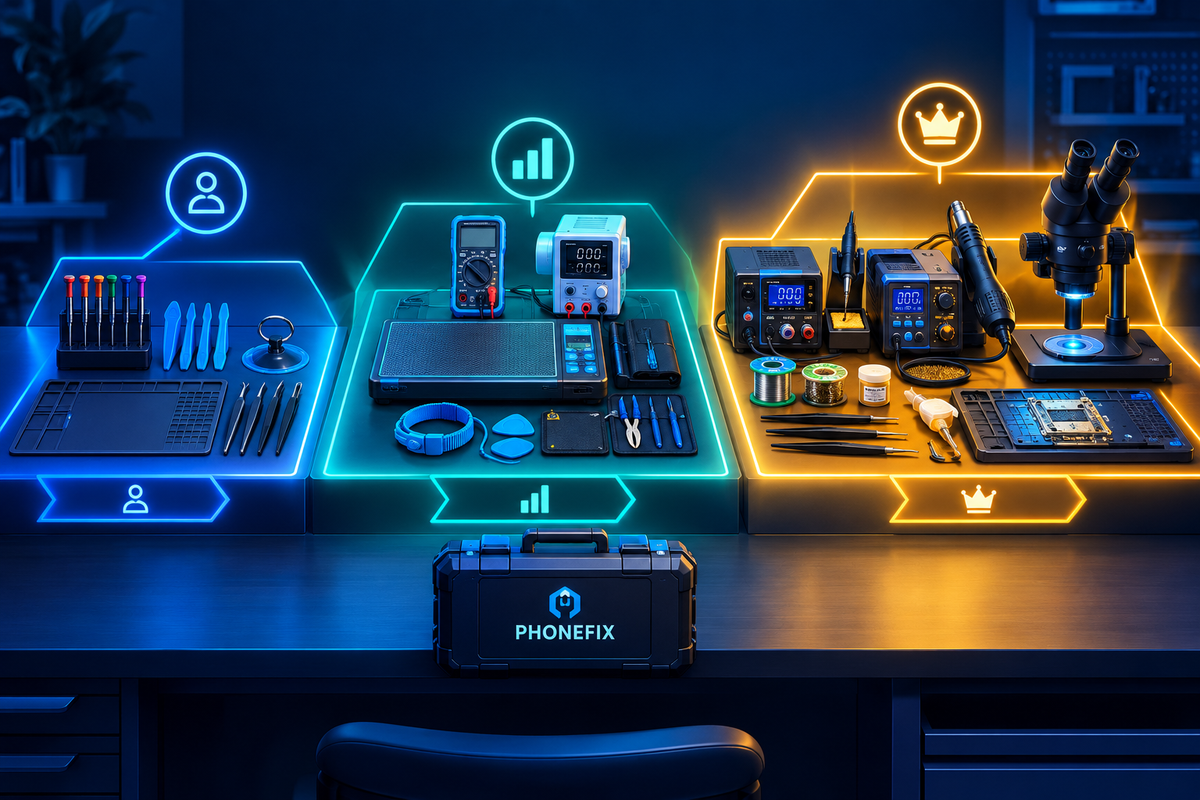
In this guide, you will learn about 15 must-have tools for any phone repair technician in 2026. It categorizes them into various budget levels, allowing you to add them to your bench in an informed way.
Purchase the inexpensive version first! Add the next level when jobs require it.
How to Read This Tool List
All the tools below are placed in three categories:
Starter: These are to be used on day one.
Scale-Up: These are necessary when scaling up certain tasks.
Pro: You’ll need these for such repairs at the board level.
Tool Summary Table
#
Tool
Tier
Main Use
1
Precision screwdriver set
Starter
Opening devices
2
Plastic pry tools
Starter
Lifting parts safely
3
Suction cups
Starter
Lifting screens
4
Magnetic mat
Starter
Screw tracking
5
Tweezers set
Starter
Handling small parts
6
Heat mat or separator
Growth
Softening adhesive
7
Digital multimeter
Growth
Testing circuits
8
Battery tester programmer
Growth
Battery data repair
9
DC power supply
Growth
Current diagnosis
10
ESD protection kit
Growth
Static safety
11
Soldering station
Pro
Part replacement
12
Hot air rework station
Pro
Chip removal
13
Microscope
Pro
Seeing tiny parts
14
Flux and solder consumables
Pro
Clean joints
15
Cleaning supplies
Pro
Board care
Starter Tier: Tools for Day One
1. Precision screwdriver set
Phones are secured with pentalobe, Phillips, and tri-point screws. Purchase a system of hardened steel bits. The screws come out fast with soft bits.
2. Plastic pry tools
Nylon spudgers pull connectors and frames up and off the board without scratching or shorting the board. Metal tools are potentially at risk.
3. Suction cups
These suction tools pull glued displays open, even with moderate, regular pressure. They reduce the potential for breakage of the glass.
4. Magnetic mat
Screws in an orderly manner on a mat. Mild cases can be halted by the misplacement of a single screw—sort them.
5. Tweezers set
Have straight, curved, and fine-tip tweezers to hand. ESD-safe protective boards against static charge.
The Growth Tier consists of tools for more advanced jobs.
Growth Tier: Tools for Harder Jobs
6. Heat mat or separator
Heat softens adhesive behind screens and back glass. A controlled heat mat works more safely than a heat gun.
7. High-precision digital multimeter
A high-precision digital multimeter sits at the heart of diagnosis. It checks continuity, voltage, and resistance, and it finds shorts on a board quickly. Choose one with a fast buzzer and fine resistance readings.
8. Battery tester programmer
There are some data chips on many new batteries. A battery tester programmer will read cycle count and capacity and will copy the data to newly collected batteries. It additionally eliminates the warning related to health that some phones show after swapping.
9. DC power supply
The battery is replaced by a regulated supply during testing. The currently displayed interpretation of the boot sequence on the phone.
10. ESD protection kit
Silently busted chips by static. Cheap and prevents expensive failures: a grounded mat and wrist strap.
Pro Tier: Tools for Board Repair
11. Soldering station
Hot air removes chips and connectors. Check to see if it can offer adjustable airflow and temperature to save nearby parts!
12. Hot air rework station
Hot air removes chips and connectors. Look for adjustable airflow and temperature so you can protect nearby parts.
13. Microscope
A stereoscopic microscope enlarges small objects. Use a screen-connected model for long job tasks to decrease eye strain.
14. Flux and solder consumables
Flux does things that ensure good flow of solder and prevent oxidation. Also stock solder wire, soldering paste, solder wick, and another type of jumper wire as well.
15. Cleaning supplies
To do this, you need to use high-purity isopropyl alcohol as well as soft brushes. Always remove flux residue after each job, as it can damage a board.
What to Skip When Money Is Tight
Skip giant 100-piece kits with soft metal bits.
Skip cheap multimeters with slow response.
Skip unbranded heat guns with no temperature control.
Skip extra gadgets until your workload demands them.
How to Lay Out Your Bench
A clean, neat bench is a minute of saved for each job. Establish it with these habits:
Keep the most frequently used tools within easy reach.
Maintain the soldering station and hot air unit out of the way of liquids.
Place the microscope in the middle and provide good illumination around the microscope.
Have labeled trays for flux, alcohol, and brushes.
Place an ESD mat on the work area and attach the strap to the ground.
Buying Tips That Protect Your Budget
Purchasing tested tools from a good tool supplier.
Change screwdriver tips that are worn.
Regularly check the accuracy of temperature instruments.
Clean and arrange your bench so that your tools are easily accessible.
FAQs
What must a new phone repair technician have?
A precision screwdriver set, plastic pry tools, suction cups, and a magnetic mat are a good first set of tools to have on hand.
Is a microscope essential in cell phone repair?
Not for monitors and cell phones. A micro soldering frame & chip work frame are required.
What will be the best diagnostic tool?
A digital multimeter is the most cost-effective complement. The next best thing is a DC power supply.
What is the cost of an entire repair bench?
Costs vary widely. A starter station as a setup is much cheaper than a full board repair station.
Why do you need a Battery Programmer?
Plenty of phones verify battery data and warn if the battery is new, but doesn’t have the data. The programmer corrects this.
Do you need ESD protection?
Yes. Static damage may manifest later as a mysterious fault.
Are you able to use a regular blow dryer rather than a heat mat?
No. A hair dryer is not very effective and provides uneven heat. Follow the correct repair equipment.
Conclusion
Any repair is completed more quickly and safely with the right tools. If you’re making your own bench, make steps to make it rise as you buy more.
Keep it simple to start and go on to diagnostics later. When soldering becomes a part of your work, invest in tools for it.
Doing the above allows you to maximize the value you derive from your tools while ensuring your bench stays clean and your tools remain high quality.