
A parent with a tape measure and a hospital with AI software want the same number: a child’s expected adult height. Free web calculators do the job at home, while hospitals now have BoneXpert, an AI program US regulators cleared in 2026.
Even the American Academy of Pediatrics (AAP) admits it’s “fun to try and predict how tall a child might be.” Fun or not, the model inside each tool decides how close that guess lands, more than the interface or price.
How Height Prediction Tools Work
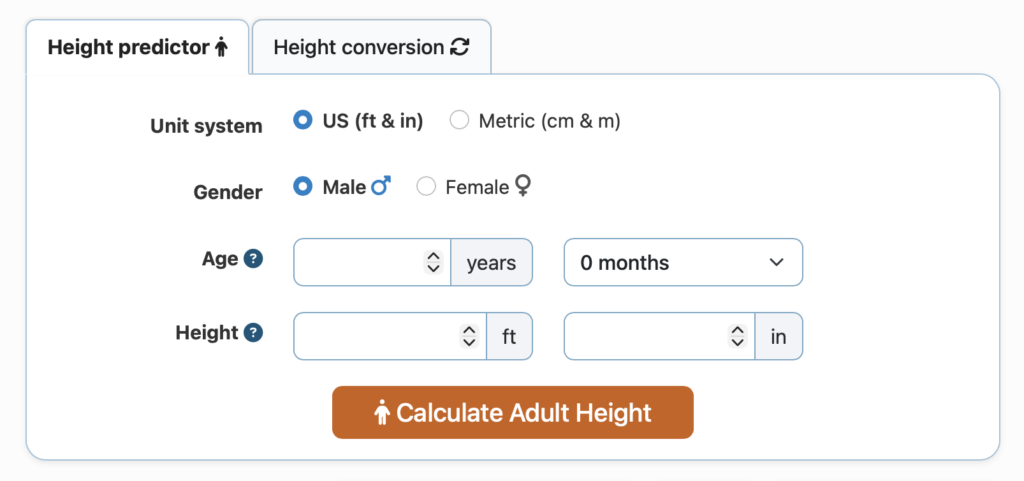
A typical session on a height prediction site takes less than a minute. Parents pick the child’s sex, type in the age and current height, and get an adult height prediction on the spot. Fancier tools add the parents’ heights, the child’s weight, or a hand X-ray. None of them can be exact, since the US National Library of Medicine calls it “difficult to accurately predict how tall a child will be.”
A sloppy measurement at home, with shoes on or a crooked book on the head, shifts the result before any formula runs. Apple’s Measure app offers another option on iPhone Pro models with LiDAR, since it measures height through the camera.
Once the number is right, an expected height calculator needs only two more inputs: the child’s sex and age. Most online height calculators run on a multiplier method, and the future height then appears in centimeters or in feet and inches.
On a test run, a 10-year-old boy at 140 cm came out at 178.92 cm, or 5 feet 10 inches. The tool got there with a multiplier of about 1.28 for boys that age. Its own guide admits the method “is prone to some error,” like any statistical method that predicts for one person.
Formulas, Lookup Tables, and AI
Under the interface, every prediction tool in this article runs one of five methods. This table pairs each of those methods with the kind of tool that uses it.
| Tool | Method behind it | Inputs |
| Mental math or any calculator | Doubling rule | Height at 18 or 24 months |
| Parent-height calculators | Mid-parental height | Both parents’ heights |
| Bone age software | Bone age reading | Hand X-ray, current height |
| Many online calculators | Khamis-Roche | Age, height, weight, parents’ heights |
| Multiplier-based calculators | Multiplier method | Age, sex, current height |
The Doubling Rule vs. Machine Learning
The doubling rule makes a handy benchmark for prediction software, since it needs only one number. Parents double a boy’s height at 24 months, or a girl’s at 18 months. Pediatric researchers in Gothenburg, Sweden, call it the “Grandma prediction,” with an average miss of 5.9 cm for boys and 5.2 cm for girls.
A machine learning study tried to beat it with a random forest model that only needed the child’s sex and height from about age 3 to 6. Most predictions landed within about 4 cm, but the model guessed too high for short children and too low for tall ones. Even so, the Gothenburg researchers called recent machine learning methods “only modestly superior” to the doubling rule.
Parent-Height Calculators
Parent-height calculators keep the form short, with boxes for both parents’ heights and the child’s sex. Behind those boxes sit a few lines of code that run the mid-parental formula. It sums both parents’ heights, adds 5 inches (about 13 cm) for a boy or subtracts 5 inches for a girl, then halves the result.
A 180 cm father and a 165 cm mother would see about 179 cm for a son and 166 cm for a daughter. The child’s own height never enters the code, so two brothers get the same answer at any age.
Even the AAP calls the result “just a very rough estimate,” with a margin of about 4 inches either way. A 1999 study also found the formula misses more when parents are very tall or short.
Bone Age Software and AI
Height prediction from an X-ray runs in two stages: a bone age reading and a formula that converts it into an adult height. Radiologists have long done the reading by eye, and two of them can disagree on the same X-ray. The formula adds its own error, since the 1952 Bayley-Pinneau tables can overshoot by over 5 cm in late-maturing boys.
BoneXpert, from the Danish company Visiana, reads bone age and also predicts adult height. European clinics have used it since 2009, and it returns an annotated image to the hospital’s system, with an outline and bone age for each bone. Across 1,285 X-rays from five US sites, its error came to 0.55 years against 0.76 for a pediatric radiologist.
The Radiological Society of North America turned bone age into a machine learning challenge with more than 14,000 hand X-rays, which drew 260 teams and individuals. Almost every entry used deep neural networks, and the winner paired an Inception V3 image model with the child’s sex. It missed by 4.2 months on average, a smaller error than one radiologist’s.
Khamis-Roche Calculators
Many online height calculators run the Khamis-Roche equations, a 1994 update of an older model that needed an X-ray. Their forms ask for the child’s age, height, and weight, plus the parents’ average height.
The weak spot is the training data, since Harry Khamis and Alex Roche worked from growth records of 433 white children in southwest Ohio. Within that group, the equations come close to the older X-ray model, with errors only slightly larger. The authors limited the method to white American children without conditions that affect growth. A web tool open to anyone in the world has no way to check who types in the numbers.
Multiplier-Based Calculators
Multiplier-based calculators, including the one from the first section, run on a lookup table and a single multiplication. Dror Paley’s team in Baltimore built that table from growth charts that the US Centers for Disease Control and Prevention (CDC) published in 2000. Each age and sex gets its own multiplier, so the software only needs the child’s current height.
When the team tested the multipliers on growth records from 52 healthy children, the median error for boys stayed between 1.4 and 4.3 cm. For girls, it ranged from 0.68 to 4.38 cm, depending on age.
The multipliers also held steady across races and generations, which suits a tool with users everywhere. Still, the method assumes a healthy child, since the team tested it only on children without growth problems.
Which Tool to Use
For a parent at home with a healthy child, a multiplier-based calculator makes the most sense. It skips the X-ray and the parents’ heights, yet comes close to bone age methods in accuracy. On top of that, it works for children of any ethnic background, which Khamis-Roche can’t claim.
For a suspected growth problem, the hospital route makes more sense, since an X-ray can show how much growth is left. Parent-height calculators work as a rough family check, while the doubling rule stays a fun guess for toddlers.
Hospital AI and a free web calculator end up closer than they seem when the child is healthy. In the AAP’s words, every method still gives “an educated guess,” and repeated checks over time show far more than any single result. A free calculator makes each of those checks a matter of seconds.
